Tehran, November 28, 1943: the Big Three agree on the landing in France, aid to Tito's Partisans and guarantees for occupied Iran
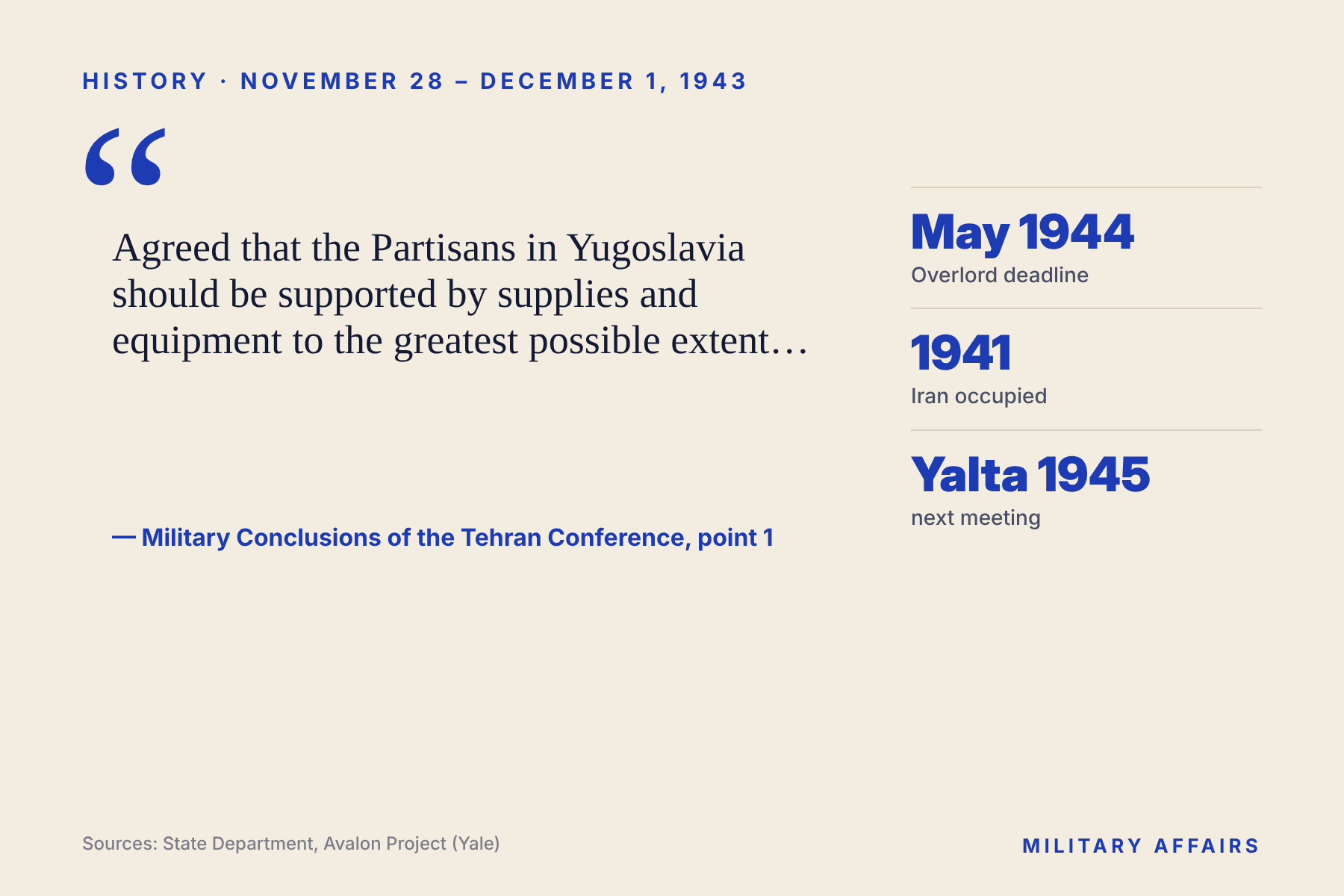
The Tehran Conference, the first wartime meeting of Franklin Roosevelt, Winston Churchill and Joseph Stalin, took place from November 28 to December 1, 1943 at the Soviet embassy in Tehran, according to the US State Department's Office of the Historian. Iran had by then been under Anglo-Soviet occupation for two years, following the invasion of August 1941.
The military conclusions, signed on December 1, open with Yugoslavia: the conference "agreed that the Partisans in Yugoslavia should be supported by supplies and equipment to the greatest possible extent, and also by commando operations," according to the text published by Yale's Avalon Project. It also noted that Operation Overlord, the landing in northern France, would launch in May 1944 alongside an operation in southern France, and that Soviet forces would then mount an offensive to stop the Germans moving troops west. The Allies also wanted Turkey in the war by the end of the year.
Iran, Japan and the Kurils
In a separate declaration the three powers recognised Iran's help "particularly by facilitating the transportation of supplies from overseas to the Soviet Union" and declared their desire to maintain its independence, sovereignty and territorial integrity. According to the State Department, Stalin agreed in principle that the USSR would declare war on Japan after Germany's defeat, and Roosevelt in return conceded Soviet demands for the Kurils and southern Sakhalin. The details were settled at Yalta in 1945.
Sources and references
- I.Office of the Historian, U.S. Department of StateThe Tehran Conference, 1943🔗 https://history.state.gov/milestones/1937-1945/tehran-conf
- II.Avalon Project, Yale Law SchoolThe Tehran Conference: Declaration of the Three Powers, Declaration Regarding Iran, Military Conclusions🔗 https://avalon.law.yale.edu/wwii/tehran.asp
- III.WikipediaTehran Conference🔗 https://en.wikipedia.org/wiki/Tehran_Conference
Keep reading
Selected long reads to continue with.
 LONG READ
Hormuz, the Red Sea and the Baltic: how freedom of navigation became a spoil of war, and why oil is still getting cheaper
 LONG READ
Europe's war reindustrialisation: how the continent is returning to arms factories and where the shift is heading
 LONG READ
After Shenzhen: what Trump, Xi and Putin achieved at the round table, and what stayed behind closed doors
 LONG READ
Comments 0
No comments yet.