Europe's war reindustrialisation: how the continent is returning to arms factories and where the shift is heading
Russia's invasion of Ukraine on February 24, 2022 ended three decades of a "peace dividend" in which Europe shrank its armed forces, closed factories and lost specialised know-how. What followed is no longer a short-term reaction to war but a long-term strategic reorientation. That is the central thesis of the article "War reindustrialization of Europe: defense industrial complexes as pillars of strategic autonomy" by Slaven Knežević of the Faculty of Political Sciences at the University of Banja Luka, published in Military Studies: Journal for Strategy, Technology and Defense Sciences (SAPCRAA, 2025, no. 2, DOI: 10.65932/military-studies-2025-2-1).
Knežević treats war reindustrialisation as a multidimensional phenomenon, at once a security, economic, technological and social one, and tests three hypotheses: that it is a long-term shift, that the process varies from state to state according to geography, historical experience and economic strength, and that a revitalised military-industrial complex is changing power relations within the EU and NATO. Two years after his sample closed, institutional data for 2025 and 2026 make it possible to test those hypotheses against new figures.
From peace dividend to war economy
The backdrop is dramatic. According to SIPRI data cited by Knežević, total military budgets of European countries fell from $314 billion in 1990 to $221 billion in 2000 (in constant 2019 prices), and the share of military spending in GDP from 3.1 to 1.9 per cent. The consequences were consolidation, plant closures, a turn to civilian production and dependence on global supply chains, including components from countries now seen as strategic rivals.
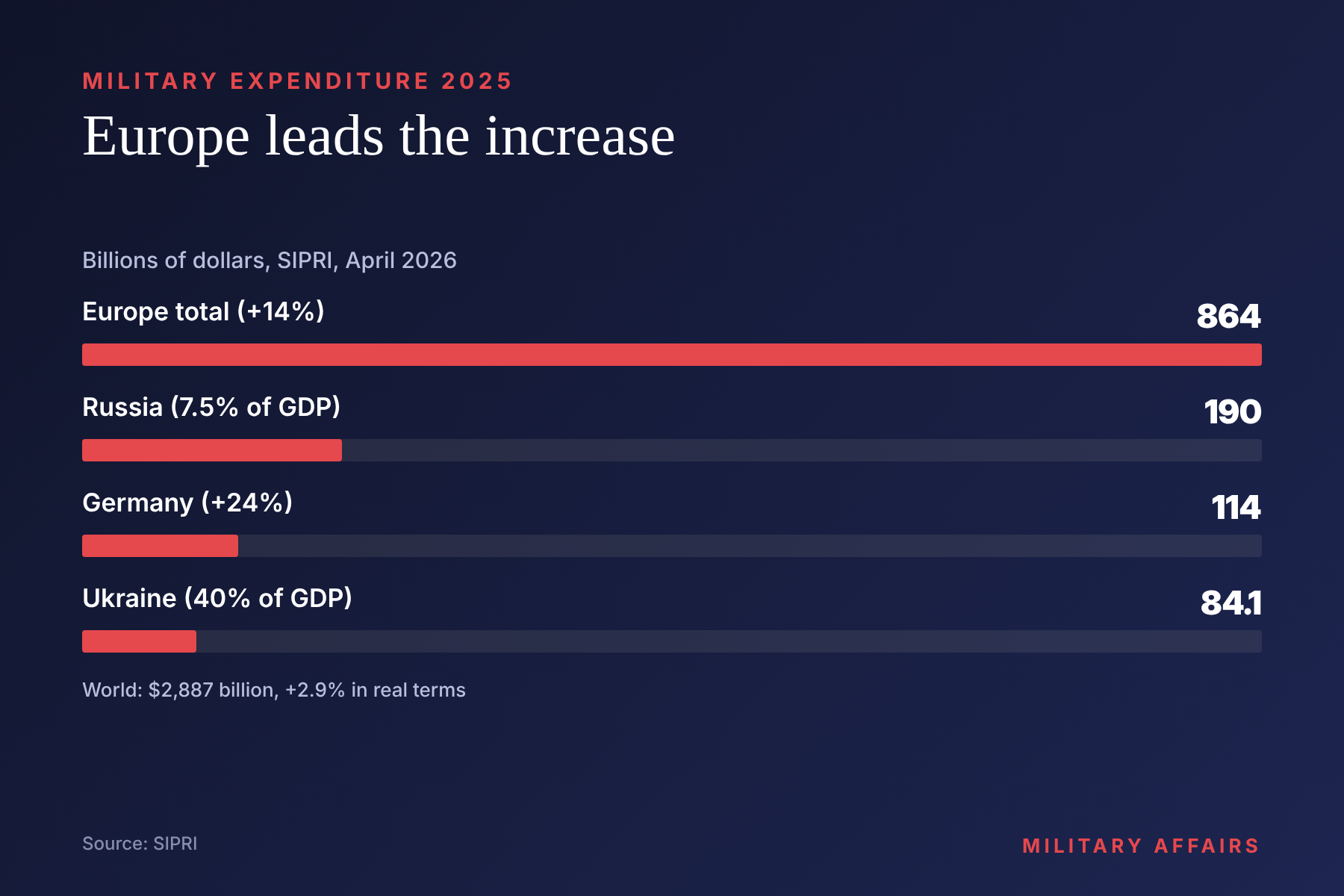
The reversal is now measurable. SIPRI reported in April 2026 that European military spending rose 14 per cent in 2025 to $864 billion, and that Europe was the main driver of growth in global spending, which reached $2,887 billion. Germany became the largest spender among NATO's 29 European members at $114 billion, up 24 per cent, or 2.3 per cent of GDP. Russia, according to SIPRI, spent $190 billion, 7.5 per cent of GDP, and Ukraine $84.1 billion, 40 per cent of GDP. "States responded to another year of wars, uncertainty and geopolitical upheaval with large-scale armament drives," said SIPRI researcher Xiao Liang.
A new architecture: loans, grants and European preference
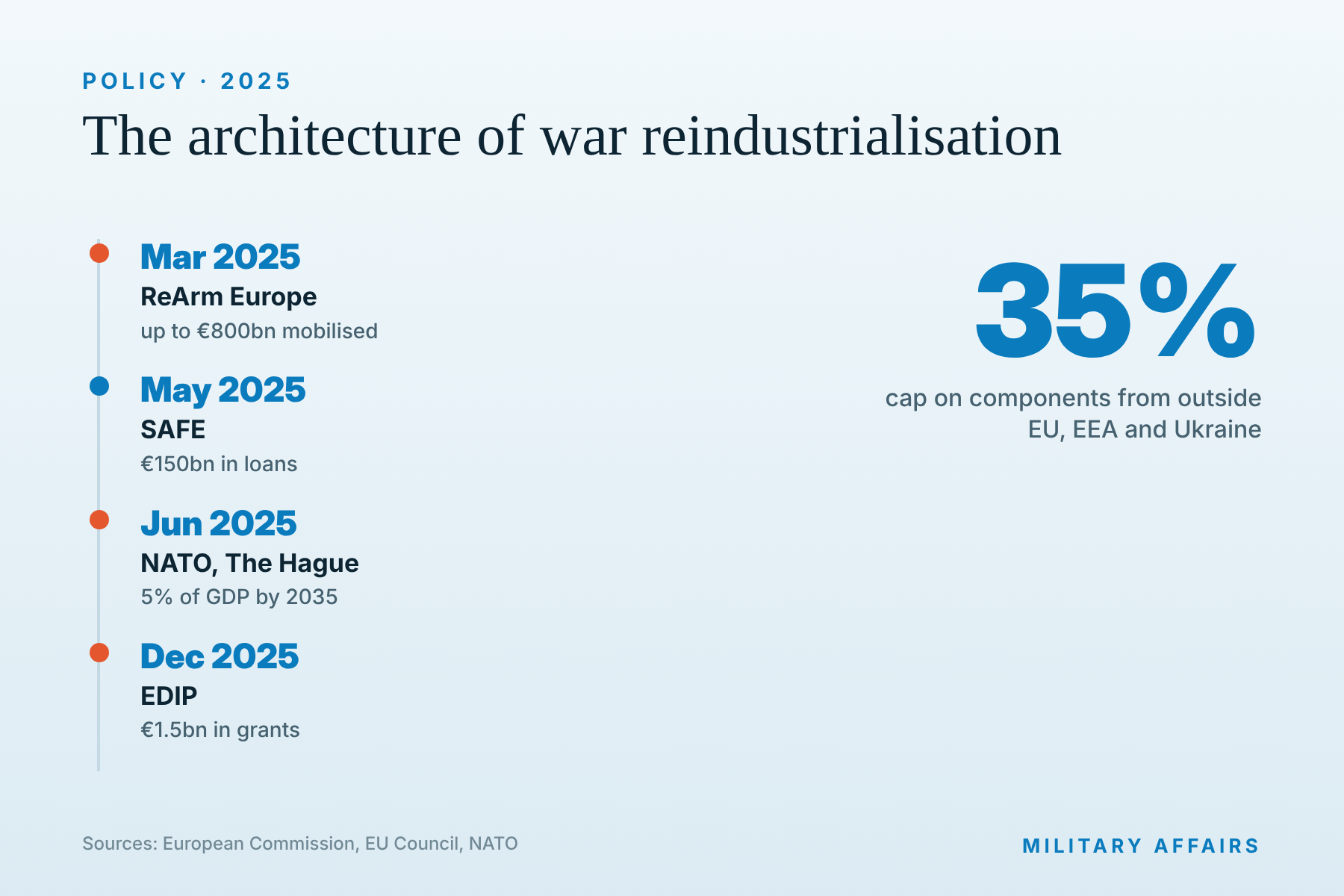
Behind the figures stands an institutional framework the EU has never had before. In March 2025 the European Commission presented the White Paper for European Defence and the ReArm Europe Plan / Readiness 2030, aiming to mobilise up to €800 billion. Its first pillar is SAFE (Security Action for Europe): up to €150 billion in long-term loans, adopted by the EU Council on May 27, 2025. The conditions are key to the direction of reindustrialisation: procurement must in principle be joint, involving at least two countries, and components originating outside the EU, the European Economic Area and Ukraine must not exceed 35 per cent of the estimated component cost of the end product. Ukraine is treated on the same terms as member states.
At its summit in The Hague in June 2025, NATO set a target of five per cent of GDP by 2035: at least 3.5 per cent for core defence and up to 1.5 per cent for related spending, including the defence industrial base. On December 9, 2025 the EU Council gave final approval to the European Defence Industry Programme (EDIP), with €1.5 billion in grants and €300 million for a Ukraine support instrument. Under the March 2026 work programme, more than €700 million is earmarked for ramping up production of key components, including counter-drone systems, missiles and ammunition.
Factories: from plans to concrete
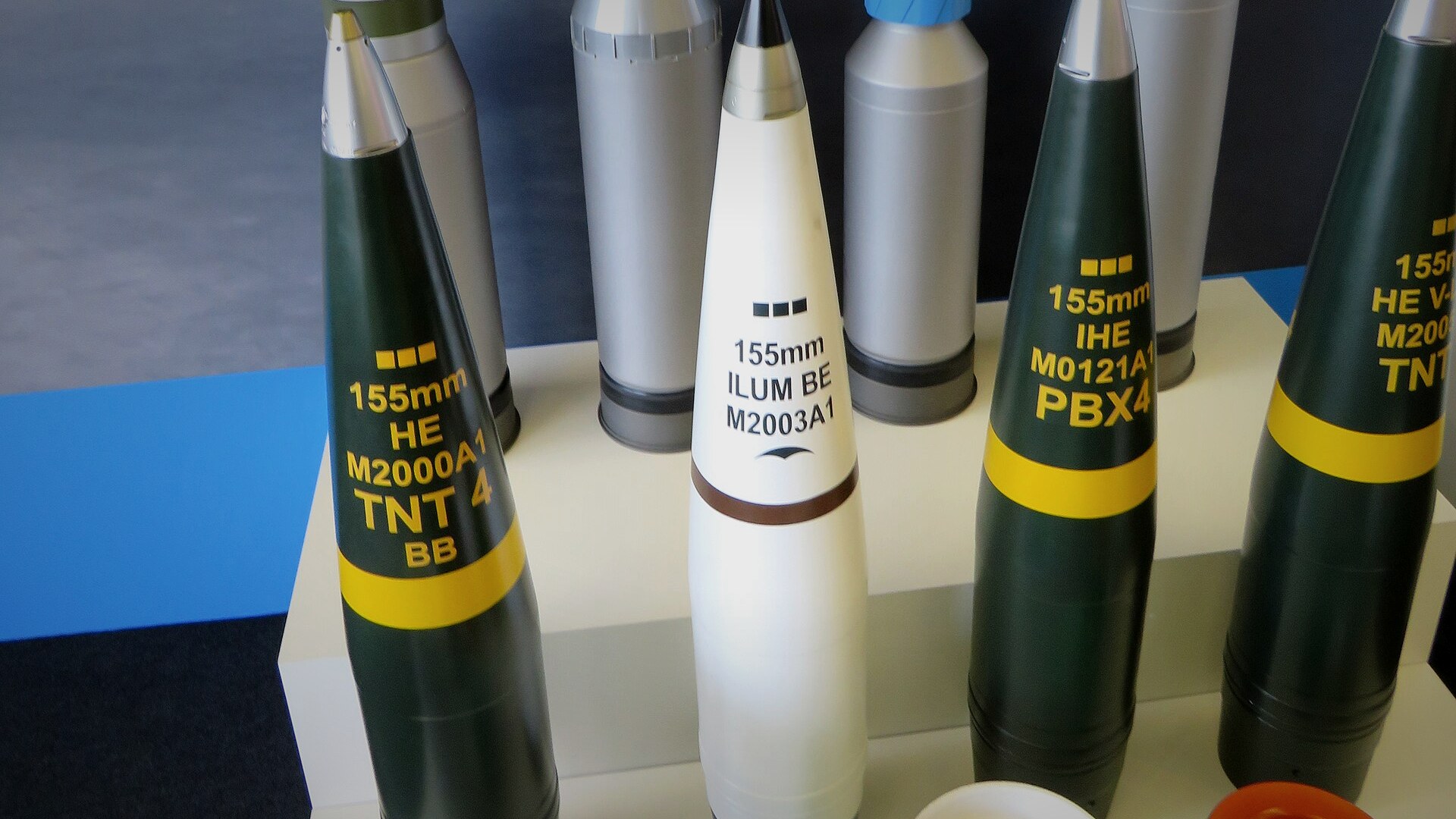
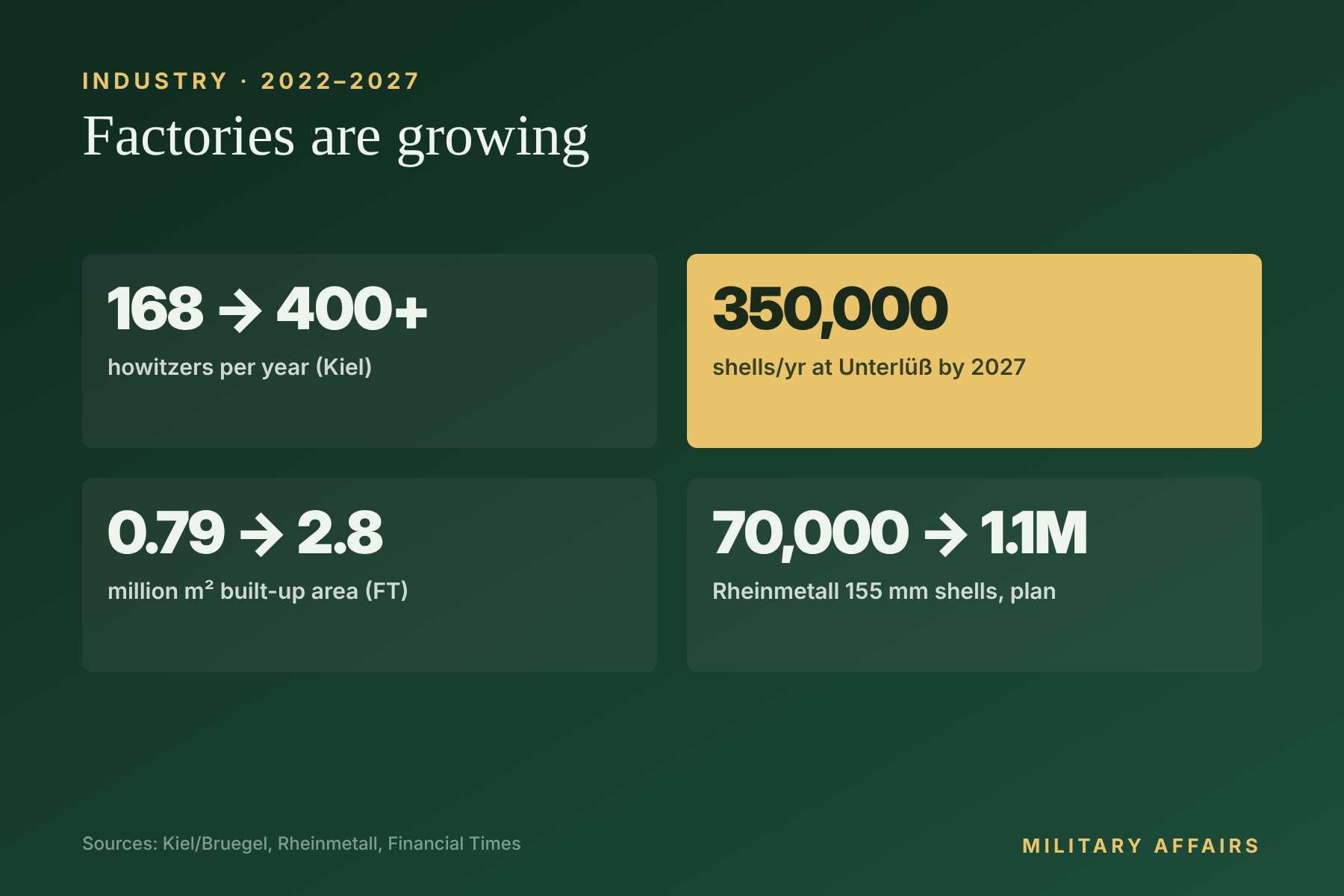
The most visible proof of the shift is the plants. In September 2025 Rheinmetall opened a factory at Unterlüß in Lower Saxony, an investment of almost €500 million built in 15 months, with capacity for up to 350,000 artillery shells a year and full capacity planned for 2027. CEO Armin Papperger said it would be "the largest ammunition plant in Europe, if not the world". According to a Financial Times analysis of satellite imagery of 150 sites belonging to 37 companies, reported by Caliber, the built-up area of those sites grew from 790,000 square metres in 2020–2021 to 2.8 million square metres in 2024–2025.
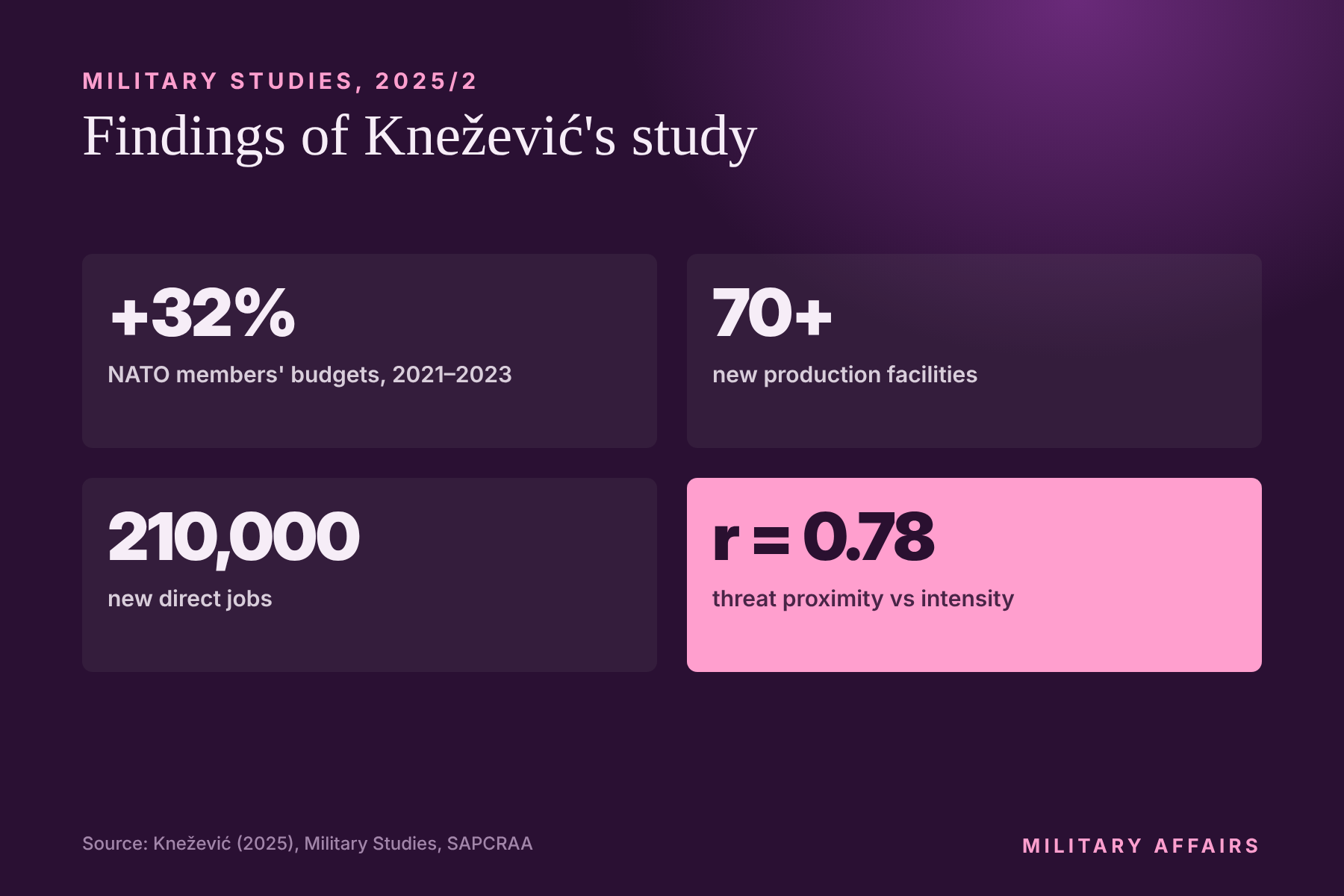
In his sample Knežević records more than 70 new production facilities and about 210,000 new direct jobs in 2022–2023, with an estimated 360,000 indirect ones. He also reports that the multiplier of military investment on GDP across 19 European countries rose from 1.6 in 2010–2020 to 2.3 in 2022–2023.
The figures should nonetheless be read with care. EU Defence Commissioner Andrius Kubilius said in February 2026 that Europe "now produces more than two million shells per year", while the Commission's directorate in November 2025 described two million 155 mm shells as an annual capacity goal. Analyses comparing these statements warn that capacity, targets and deliveries are often conflated. The Kiel Institute and Bruegel, in the report "Fit for war by 2030?", estimate that European shell output is "nearly meeting" the requirements of credible deterrence and that more than 400 howitzers a year are now produced, up from 168 in 2022.
The geography of threat: three Europes
Knežević's second finding may be the most important for understanding the direction of travel. He distinguishes three zones of threat perception: frontline states (the Baltic countries, Poland, Romania and Finland), where the threat is seen as existential and immediate; concerned supporters (Germany, France, the UK), where it is serious but not immediate; and distant observers (Spain, Portugal, Italy). According to his analysis, the correlation between geographic proximity to the threat and the intensity of reindustrialisation is r = 0.78.
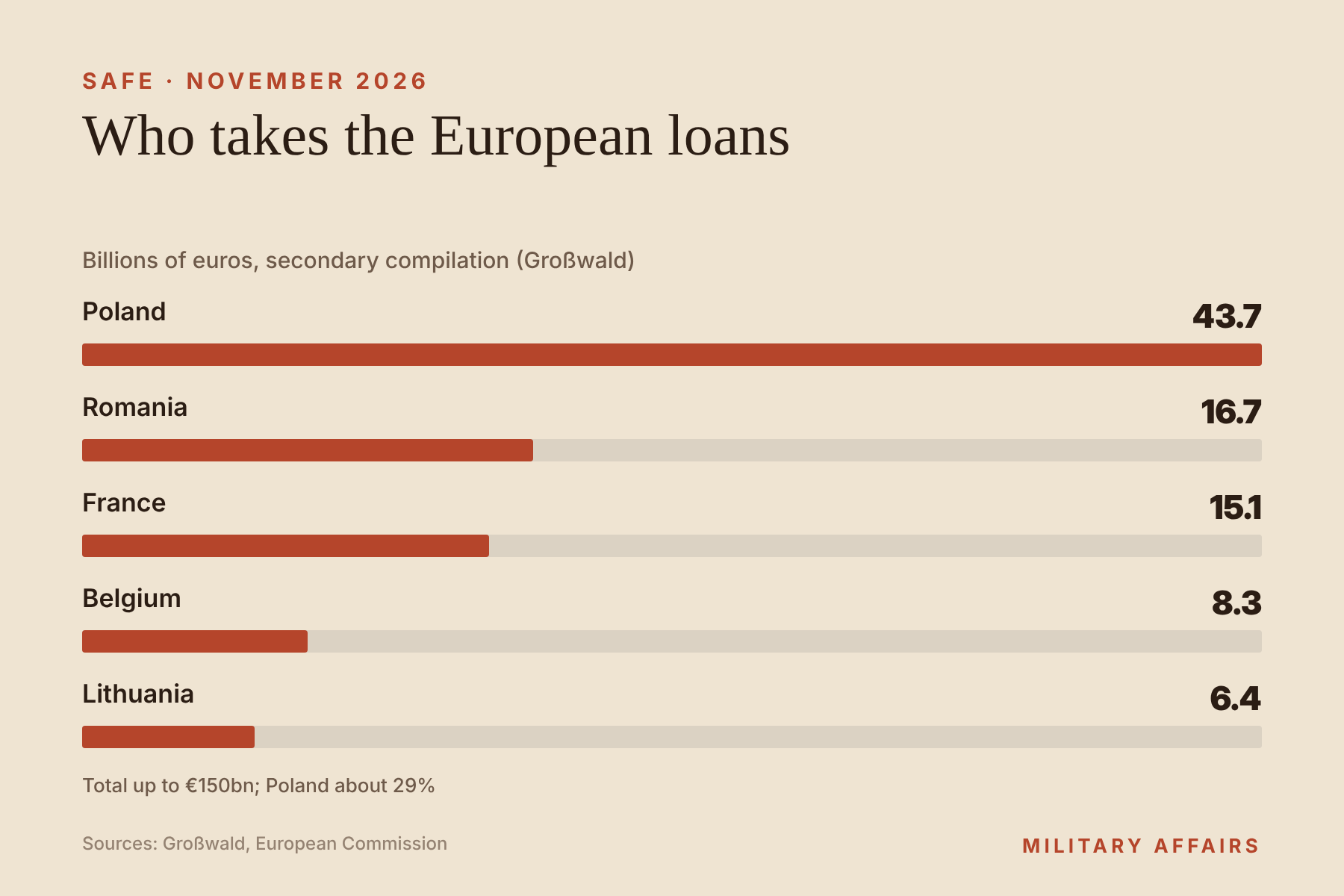
Data for 2026 support that thesis. Poland planned a record 4.8 per cent of GDP for defence in its 2026 budget, Notes from Poland reports. According to the secondary compilation Großwald, Poland received €43.7 billion from SAFE, about 29 per cent of the total, and contracts worth more than PLN 120 billion were signed, according to the same source, 94 per cent with domestic industry. Romania, according to the European Commission, is entitled to €16.68 billion. SAFE is thus becoming a mechanism that channels money precisely towards the eastern flank.
Three models of industrial policy
Knežević identifies three models through which European states approach reindustrialisation: a market model that prioritises efficiency; a state-directed model focused on strategic autonomy; and a hybrid model of "managed interdependence", which in his assessment predominates. The SAFE and EDIP rules are the hybrid model in practice: the money is European but conditioned on joint procurement; the market stays open but with a 35 per cent cap on outside components; and Ukraine is brought in as a production partner, not just an aid recipient.
Bottlenecks
The shift has clear limits. Kiel and Bruegel estimate that production of tanks and infantry fighting vehicles would need to rise up to sixfold, and that missile and combat aircraft output is "well below" the required level. Europe spends about €13 billion a year on defence research and development, against $145 billion in the US. "Despite the sharp increase in defense spending, Europe's rearmament efforts may falter unless defense market integration across the continent progresses," warns study co-author Guntram Wolff.
Energy is a new bottleneck. The European Commission, according to a draft document cited by Euronews, wants states to secure diesel and jet fuel for military operations, and Commissioner Kubilius says NATO could need to move and sustain 100,000 troops in the first ten days of a crisis. Europe imports 27 to 30 per cent of its jet fuel from outside the region.
Where the shift is heading
Four directions emerge from the data so far:
- From national to joint procurement. SAFE and EDIP tie money to cooperation among at least two or three countries. It is an attempt to break the fragmentation that Knežević and Kiel see as the main weakness of European industry.
- European preference as industrial policy. The 35 per cent rule turns defence spending into a tool for building European supply chains, at the risk of higher prices and slower deliveries.
- A shift of the centre of gravity eastwards. Poland, Romania and the Baltic states are becoming new industrial centres, which supports Knežević's hypothesis about shifting power relations within the EU and NATO, though he himself judges it only partly confirmed so far.
- Ukraine as part of Europe's defence base. Ukraine is treated as a partner in SAFE and EDIP, and part of the programmes is earmarked for modernising its industry.
Assessment
Data for 2025 and 2026 confirm Knežević's first hypothesis: Europe's war reindustrialisation is not a passing reaction but an institutionalised shift, built into budgets to 2035, into loans with maturities of decades and into procurement rules. The second is confirmed too: the process is most intense where the threat is closest. The third question, how the new military-industrial complex changes power relations, remains open, and that is where the greatest risks lie.
Knežević concludes that what is needed is a revision of military-economy concepts developed after the Cold War, a balance between national priorities and collective efficiency, management of the fiscal risks of rapid increases in military spending, and preservation of democratic oversight over the growing military-industrial complex. In three years Europe has shown it can find the money. The next decade will show whether it can turn that money into an industry that is at once large enough to deter Russia, integrated enough to be efficient and controlled enough to remain subordinate to democratic institutions.
Sources and references
- I.Knežević, S. (2025), Military Studies: Journal for Strategy, Technology and Defense Sciences (SAPCRAA)War reindustrialization of Europe: defense industrial complexes as pillars of strategic autonomy🔗 https://sapcraa.com/api/articles/1529/War%20reindustrialization%20of%20Europe%3A%20defense%20industrial%20complexes%20as%20pillars%20of%20strategic%20autonomy.pdf
- II.DOI10.65932/military-studies-2025-2-1🔗 https://doi.org/10.65932/military-studies-2025-2-1
- III.SIPRIGlobal military spending rise continues as European and Asian expenditures surge (27. 4. 2026)🔗 https://www.sipri.org/media/press-release/2026/global-military-spending-rise-continues-european-and-asian-expenditures-surge
- IV.NATOThe Hague Summit Declaration (25. 6. 2025)🔗 https://www.nato.int/en/about-us/official-texts-and-resources/official-texts/2025/06/25/the-hague-summit-declaration
- V.Evropska komisijaWhite Paper for European Defence and the ReArm Europe Plan / Readiness 2030🔗 https://defence-industry-space.ec.europa.eu/eu-defence-industry/white-paper-future-european-defence-rearming-europe_en
- VI.Savjet EUSAFE: Council adopts €150 billion boost for joint procurement (27. 5. 2025)🔗 https://www.consilium.europa.eu/en/press/press-releases/2025/05/27/safe-council-adopts-150-billion-boost-for-joint-procurement-on-european-security-and-defence/
- VII.Evropska komisijaFirst wave of SAFE defence funding for eight Member States (15. 1. 2026)🔗 https://www.globalsecurity.org/military/library/news/2026/01/mil-260115-european-commission01.htm
- VIII.EEAS / Savjet EUEuropean Defence Industry Programme: Council gives final approval (9. 12. 2025)🔗 https://www.eeas.europa.eu/delegations/ukraine/european-defence-industry-programme-council-gives-final-approval_en
- IX.Evropska komisijaEDIP work programme (30. 3. 2026)🔗 https://defence-industry-space.ec.europa.eu/edip-commission-adopts-eu15-billion-work-programme-boost-european-and-ukrainian-defence-industry-2026-03-30_en
- X.Kiel Institute / BruegelDespite billions in spending, Europe's military build-up risks falling short (20. 6. 2025)🔗 https://www.kielinstitut.de/media/news/despite-billions-in-spending-europes-military-build-up-risks-falling-short
- XI.RheinmetallOpening of the Unterlüß ammunition plant (5. 9. 2025)🔗 https://www.rheinmetall.com/Rheinmetall%20Group/Presse/News/Documents/2025/09/2025-09-05-factory-opening-in-unterluess.pdf
- XII.Caliber.az / Financial TimesEurope's arms industry triples peacetime growth🔗 https://caliber.az/en/post/ft-europe-s-arms-industry-triples-peacetime-growth
- XIII.Strategic Revenue InsightsEU shell output: what the 2 million figure counts🔗 https://www.strategicrevenueinsights.com/blogs/does-europe-really-make-2-million-155mm-shells-a-year
- XIV.Notes from PolandPoland plans record defence spending of 4.8% GDP in 2026 budget🔗 https://notesfrompoland.com/2025/08/29/poland-plans-record-defence-spending-of-4-8-gdp-in-2026-budget-along-with-lower-deficit/
- XV.GroßwaldSAFE: The €150 billion EU defence loan, country by country🔗 https://www.grosswald.org/safe-defence-loans-tracker/
- 16.EuronewsEU puts military fuel needs at heart of new oil security strategy (20. 11. 2026)🔗 https://www.euronews.com/2026/11/20/brussels-puts-military-fuel-needs-at-heart-of-new-oil-security-strategy
- 17.Wikimedia CommonsRhenmetall ammo.jpg (Admiralis-generalis-Aladeen, CC BY-SA 4.0)🔗 https://commons.wikimedia.org/wiki/File:Rhenmetall_ammo.jpg
- 18.Wikimedia Commons / DVIDSAllied Spirit 24 (Cdt. Ayden Norcross, javno dobro)🔗 https://commons.wikimedia.org/wiki/File:Allied_Spirit_24_Participants_Conduct_Artillery_Training_(8290232).jpg
Keep reading
Selected long reads to continue with.
 LONG READ
After Shenzhen: what Trump, Xi and Putin achieved at the round table, and what stayed behind closed doors
 LONG READ
Shenzhen: the first Trump–Xi–Putin meeting and the limits of the big three
 LONG READ
Nvidia on three fronts: a selloff, a spy scandal and China a week before decisive results
 LONG READ
Comments 0
No comments yet.