Operation Uranus, November 19, 1942: how the Red Army encircled the 6th Army at Stalingrad in four days
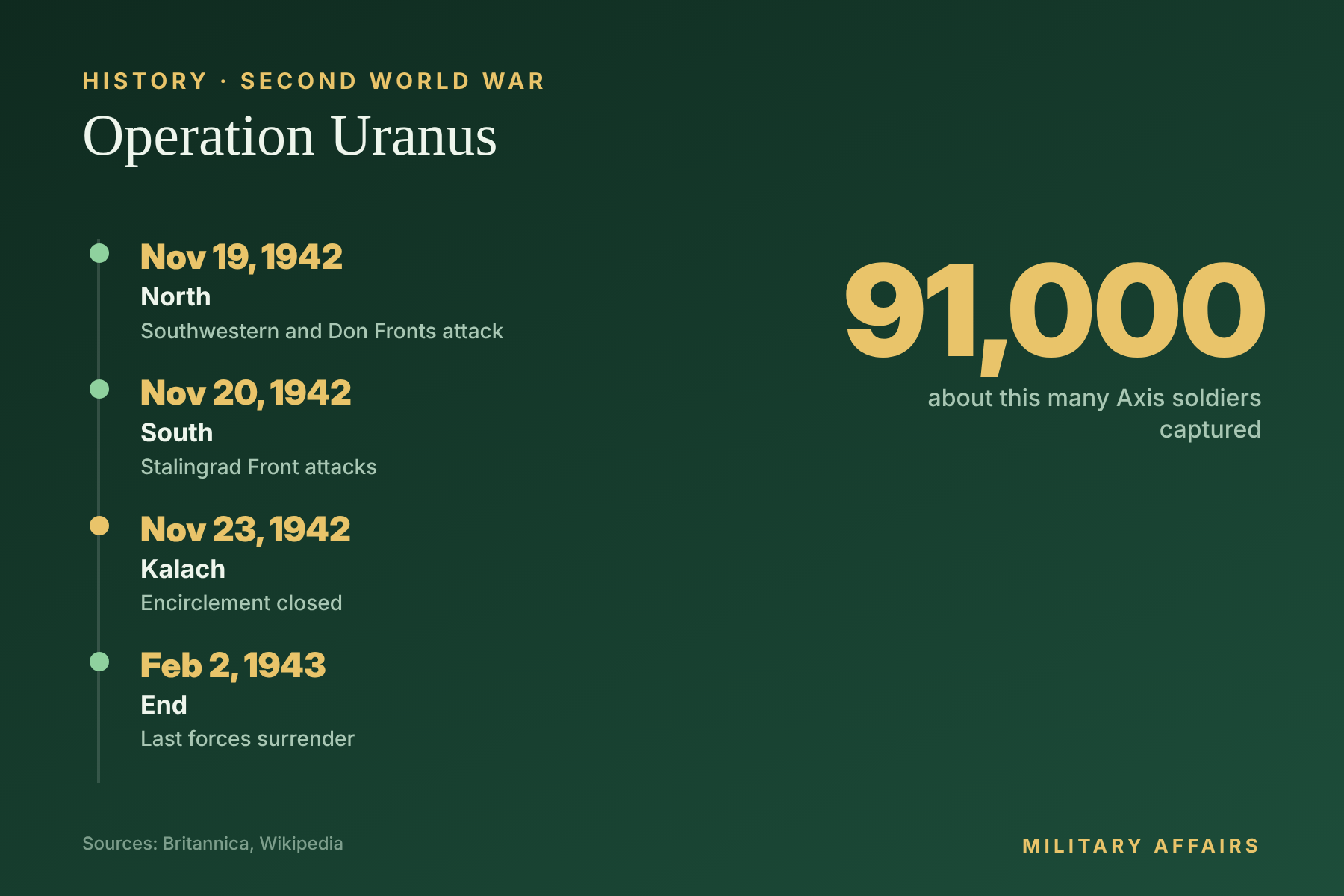
On November 19, 1942, the Red Army launched Operation Uranus, a counteroffensive that encircled the German 6th Army at Stalingrad within four days, according to Encyclopaedia Britannica and histories of the battle. On the first day the Southwestern and Don Fronts attacked north of the city, followed on November 20 by the Stalingrad Front from the south.
The key to the plan was where to strike: instead of the exhausted German divisions in the city's ruins, the Soviet blows fell on the Romanian 3rd and 4th Armies, which held long and poorly equipped flanks. Both were quickly broken, and the armoured spearheads met at Kalach on the Don on November 23.
Consequences
Most estimates put between 250,000 and 300,000 Axis troops inside the pocket, including General Friedrich Paulus's 6th Army and parts of the 4th Panzer Army. Hitler forbade a breakout, and the Luftwaffe airlift could not deliver enough supplies. Paulus surrendered on January 31, 1943, and the last forces in the northern pocket on February 2. About 91,000 soldiers were taken prisoner.
Stalingrad is regarded as the turning point of the war on the Eastern Front: Germany never again launched a strategic offensive of that scale in the south of the Soviet Union.
Sources and references
- I.Encyclopaedia BritannicaBattle of Stalingrad🔗 https://www.britannica.com/event/Battle-of-Stalingrad
- II.WikipediaOperation Uranus🔗 https://en.wikipedia.org/wiki/Operation_Uranus
Keep reading
Selected long reads to continue with.
 LONG READ
Shenzhen: the first Trump–Xi–Putin meeting and the limits of the big three
 LONG READ
Nvidia on three fronts: a selloff, a spy scandal and China a week before decisive results
 LONG READ
Dodik at Mar-a-Lago: a photo, messages and the limits of lobbying
 LONG READ
Comments 0
No comments yet.