AVNOJ at Jajce, November 29, 1943: of 303 planned delegates 142 arrived, and their decisions barred the king's return and set up six republics
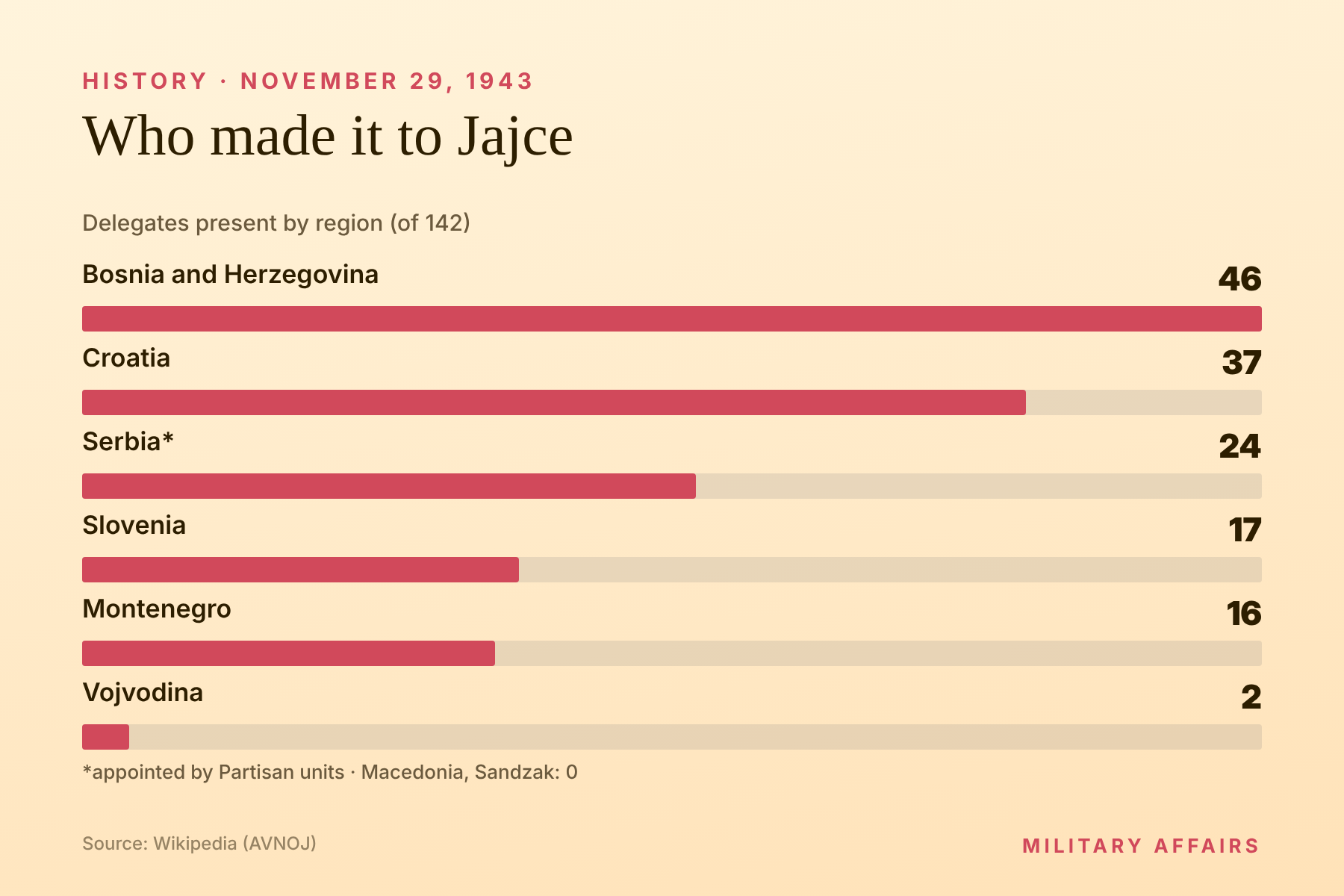
The Anti-Fascist Council for the National Liberation of Yugoslavia (AVNOJ) reconvened in Jajce on November 29 and 30, 1943, chaired by Ivan Ribar, according to Wikipedia, drawing on the historiography of the war in Yugoslavia. It had originally planned 250 delegates elected by regional councils, a number raised by 53 to include Macedonia and the Sandzak. Of the planned 303, 142 delegates had arrived by the start of the session, along with 163 deputy delegates.
No one came from Macedonia or the Sandzak. The Main National Liberation Committee for Serbia could not hold elections because of the German occupation, so Serbian delegates were appointed by Partisan units originally from Serbia, leaving the east of the country underrepresented. The largest groups came from Bosnia and Herzegovina (46) and Croatia (37).
Six units and a ban on the king
AVNOJ declared itself the supreme legislative body and the representative of Yugoslav sovereignty, committed to a democratic federation and recognised the equal standing of Bosnia and Herzegovina, Croatia, Macedonia, Montenegro, Serbia and Slovenia. It denied the legitimacy of the government-in-exile and barred King Peter II from returning until the people decided on the monarchy after the war. Tito was made Marshal of Yugoslavia and president of the National Committee for the Liberation of Yugoslavia (NKOJ), the interim government. In the same days, the Allies at Tehran concluded that the Partisans should be supported "to the greatest possible extent."
Sources and references
- I.WikipediaAnti-Fascist Council for the National Liberation of Yugoslavia🔗 https://en.wikipedia.org/wiki/Anti-Fascist_Council_for_the_National_Liberation_of_Yugoslavia
- II.Avalon Project, Yale Law SchoolThe Tehran Conference, Military Conclusions🔗 https://avalon.law.yale.edu/wwii/tehran.asp
Keep reading
Selected long reads to continue with.
 LONG READ
Hormuz, the Red Sea and the Baltic: how freedom of navigation became a spoil of war, and why oil is still getting cheaper
 LONG READ
Europe's war reindustrialisation: how the continent is returning to arms factories and where the shift is heading
 LONG READ
After Shenzhen: what Trump, Xi and Putin achieved at the round table, and what stayed behind closed doors
 LONG READ
Comments 0
No comments yet.