Carbon sinking into the deep ocean off Antarctica holds a surprise: an AWI study in the Weddell Sea
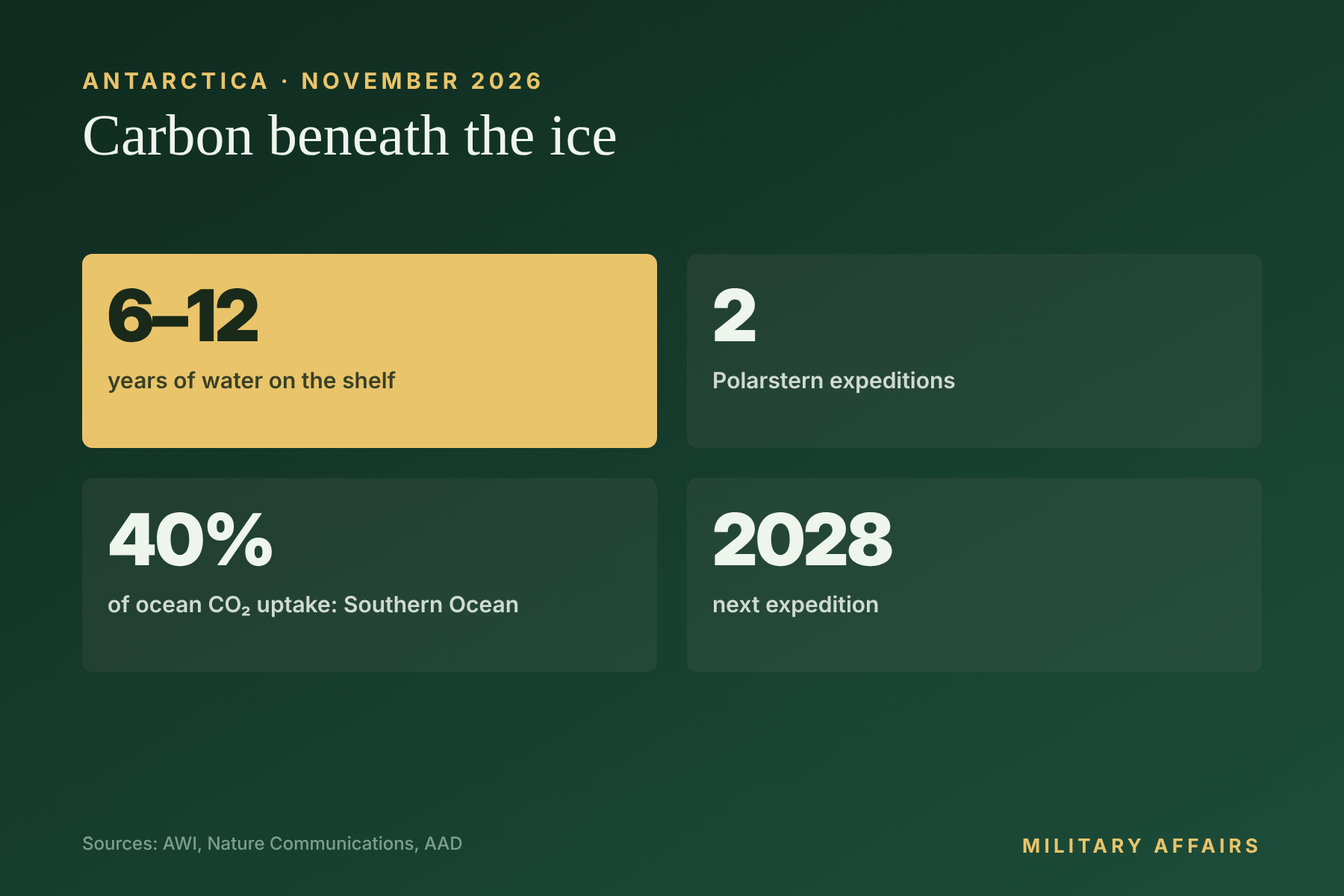
Researchers from the Alfred Wegener Institute (AWI) and the University of Oldenburg found that dissolved organic matter barely changes as dense water from the Antarctic shelf sinks into the depths of the Weddell Sea, Earth.com reports. The study, published in Nature Communications, is based on samples from two Polarstern expeditions to the southern Weddell Sea, in 2016 and 2021.
The explanation lies in time: dense water stays on the shelf for six to 12 years and circulates beneath the Filchner–Ronne Ice Shelf. During that time microbes convert new organic matter into dissolved inorganic carbon, so material with similar molecular properties reaches the deep ocean. "The molecular properties of dissolved organic matter are conserved during deep-water formation," says lead author Gonzalo Gomez-Saez of AWI.
The Southern Ocean and climate
The Southern Ocean covers about 30% of the global ocean surface and takes up about 40% of the carbon dioxide absorbed by the oceans, the Australian Antarctic Division notes. Co-author Alexander Haumann will help lead a 2028 Polarstern expedition on carbon in the Antarctic winter.
Sources and references
- I.Earth.comCarbon sinking into Antarctica's deep ocean holds a surprise🔗 https://earth.com/climate/carbon-sinking-into-antarcticas-deep-ocean-holds-a-surprise
- II.Nature CommunicationsStudy🔗 https://www.nature.com/articles/s41467-026-79040-4
- III.Australian Antarctic DivisionWhat temperature overshoot means for Antarctica and the Southern Ocean🔗 https://www.antarctica.gov.au/news/2026/what-temperature-overshoot-means-for-antarctica-and-the-southern-ocean/
Keep reading
Selected long reads to continue with.
 LONG READ
Europe's war reindustrialisation: how the continent is returning to arms factories and where the shift is heading
 LONG READ
After Shenzhen: what Trump, Xi and Putin achieved at the round table, and what stayed behind closed doors
 LONG READ
Shenzhen: the first Trump–Xi–Putin meeting and the limits of the big three
 LONG READ
Comments 0
No comments yet.