Nvidia on three fronts: a selloff, a spy scandal and China a week before decisive results
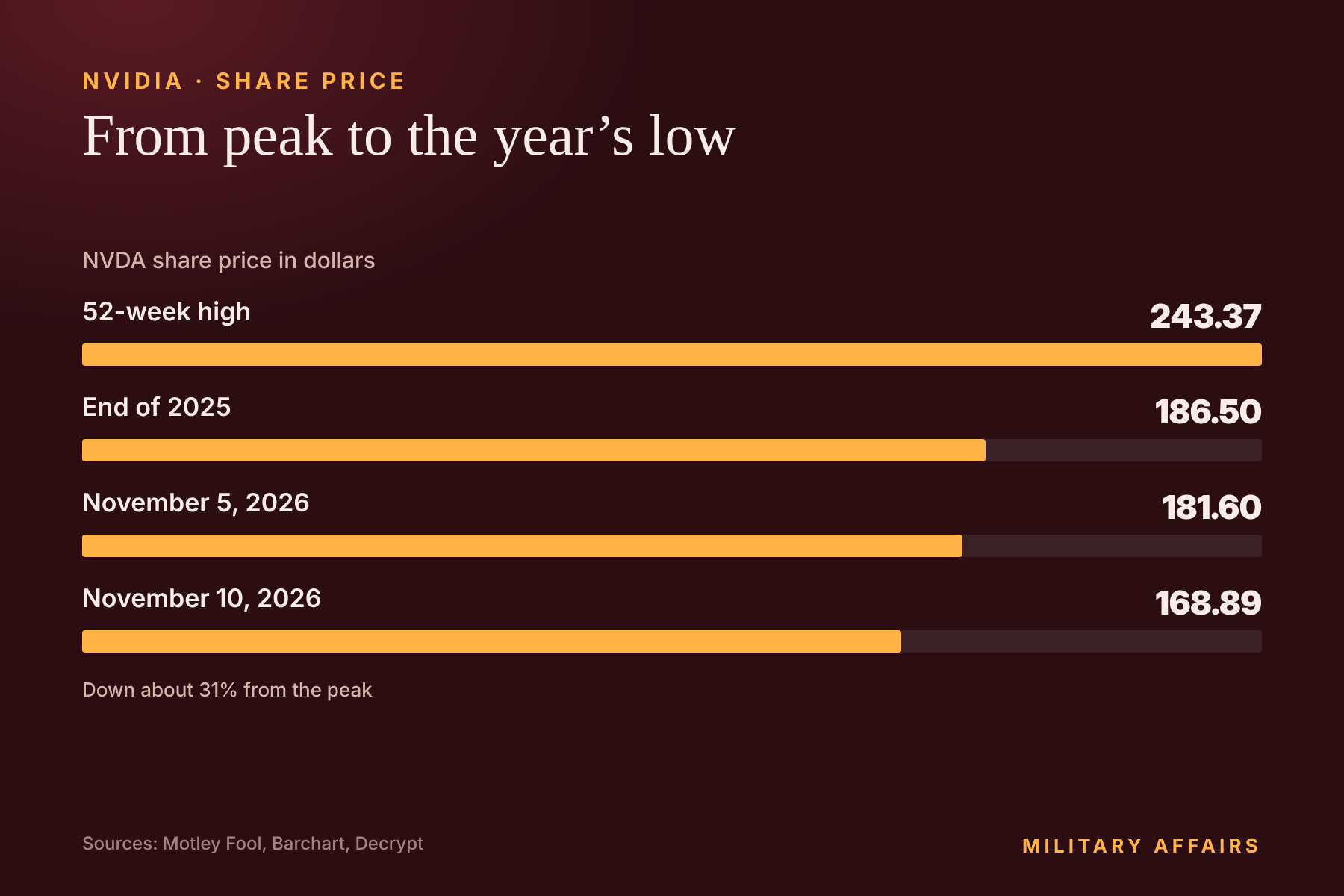
Nvidia shares closed at $168.89 on November 10, down 5.47 per cent and at their lowest since April. That is about 31 per cent below the $243.37 peak and about nine per cent below the end-2025 price, wiping out all of the company's gains for the year. According to Reuters, more than $470bn of market value disappeared on Monday and Tuesday alone, and Decrypt calculates that November is on track to be the stock's worst month since September 2022.
The fall is not one event but three overlapping crises: a market crisis, a personal one and a geopolitical one. Each alone would be manageable. Together, a week before quarterly results on November 17, they change how investors and the state view the company that makes the most important strategic chip of our time.
The first front: elections and fear of the end of the investment boom
The selloff began before the scandal. After Democrats won Congress on November 3, investors began recalculating the future of data-centre construction. Motley Fool notes that one Texas governor-elect campaigned on pausing data-centre building, and UBS estimates that nearly a third of new US capacity planned for 2028 could be delayed or lost. Data-centre builders and power-equipment makers fell by 20 per cent or more.
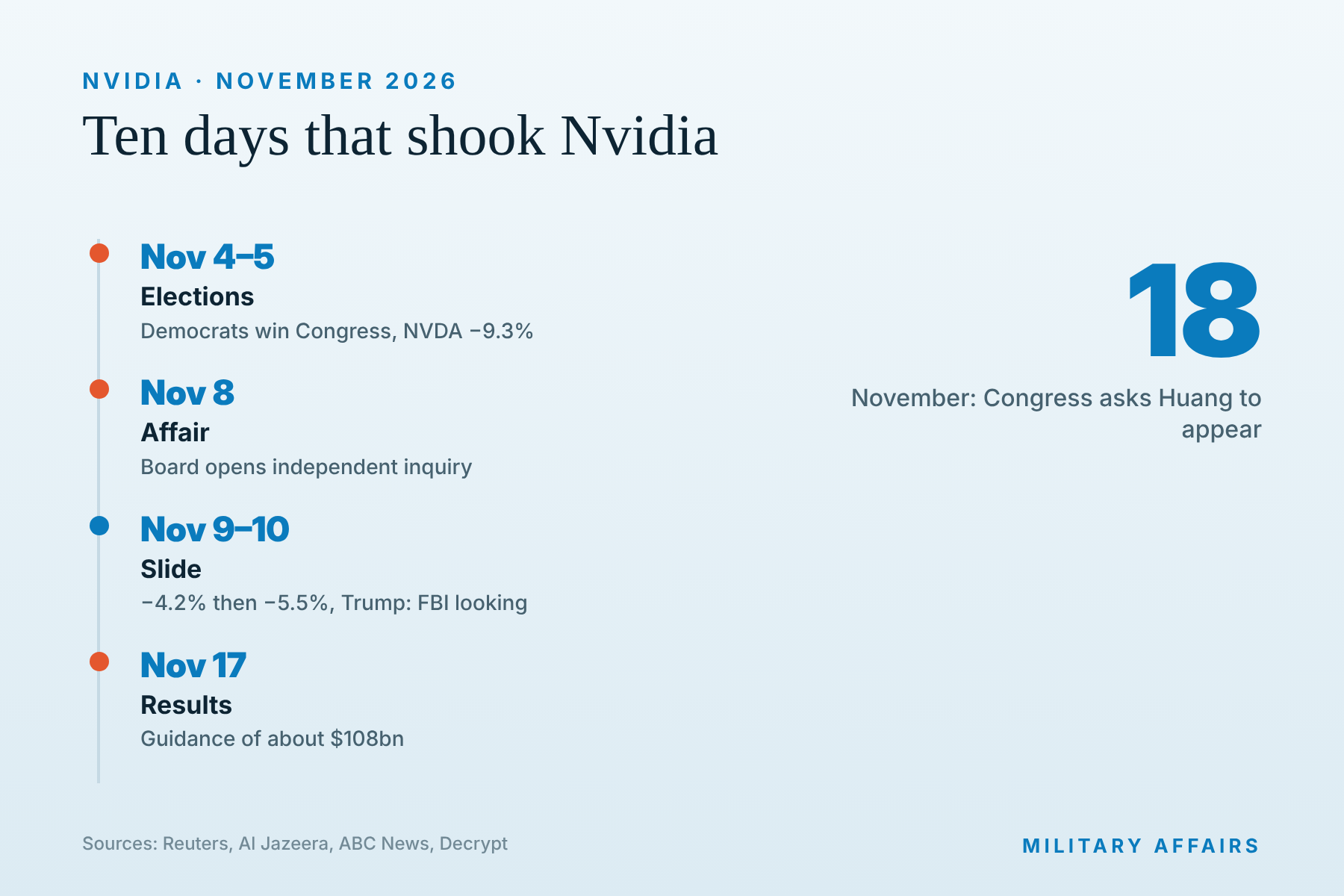
On November 5 the Nasdaq-100 fell 6.36 per cent, AMD 17.26 per cent and Nvidia 9.26 per cent, to $181.60. Analysts cited doubts about demand, political uncertainty and questions of "monetization efficiency, financing, and electricity sourcing", Motley Fool reports.
The key signal came on November 9. Wall Street rebounded and the semiconductor index rose 6.9 per cent, but Nvidia was the only stock in that index to fall, by 4.2 per cent, Reuters reports. That day the market stopped punishing the sector and started punishing one company.
The second front: an affair that became a national-security question
The New York Times and the Financial Times, citing unnamed US intelligence officials, reported that chief executive Jensen Huang had a relationship with Alice Huang, a former executive at Singapore-based chip buyer Megaspeed. US intelligence suspects her of working for China's Ministry of State Security. She is not related to Jensen Huang. She has not commented publicly, and China's foreign ministry called the claims "entirely groundless" and intended to "smear and malign China".
In a message to employees, Huang admitted to an extramarital relationship: "There is no excuse for what I did." On November 8 the board launched an independent inquiry into whether the chief executive was targeted by a foreign intelligence operation, saying it had "no reason to believe" national security or company secrets were compromised. The Financial Times reports that former federal prosecutor Joon H. Kim is leading the inquiry. According to Citi analyst Atif Malik, the company has said Huang will remain chief executive while the investigation proceeds.
President Trump stood by Huang but also confirmed the agencies' interest: "I know the FBI is looking into it… I think he'll be in good shape," he said, as reported by AP. According to Bloomberg, Nvidia general counsel Tim Teter contacted Jeffrey Kessler, head of the Bureau of Industry and Security (BIS), about the investigation into Megaspeed and asked whether BIS had a role in Alice Huang's detention in Singapore. Nvidia says it vetted Megaspeed and found no diversion of chips. The Information reports that the relationship dates to 2023 and enabled Chinese firms to buy $7.5bn of Nvidia chips, but this is unconfirmed, and one of the firms named denies any dealings with her.
House Foreign Affairs Committee chairman Brian Mast told ABC News he was prepared to issue a subpoena if Huang did not agree by November 11 to a closed-door briefing. According to Decrypt, Mast and two other Republican committee chairs asked Huang to appear on November 18. Investors have meanwhile filed a class action over undisclosed risks.
It is important to separate what is established from what is alleged. The relationship, the board inquiry and the interest of the FBI and Congress are established. It has not been established that Alice Huang is a spy, or that Jensen Huang knowingly disclosed confidential information or broke export rules.
The third front: China and export controls
The scandal hit the most sensitive point of Nvidia's strategy. Huang has for years been the loudest lobbyist against export restrictions on China. In December 2025 Trump approved sales of H200 chips to China on condition that 25 per cent of revenue goes to the US government, but he still refuses to allow exports of the Blackwell architecture, about 2.5 times more powerful, Al Jazeera notes. According to an Epoch AI estimate, chips equivalent to 1.6 million H100s had been smuggled into China by the end of 2025 despite the bans.
Advocates of a tougher line now have the argument they lacked. Senators Elizabeth Warren and Jim Banks, a Democrat and a Republican, are calling for passage of the AI Overwatch Act, which would give Congress the power to halt exports of advanced chips to China. Representatives Bill Foster and Bill Huizenga back the Chip Security Act, which would track the location of chips abroad. If either passes, Nvidia loses what Trump's compromise gave it: politically predictable access to its largest market outside the US.
The paradox: the best numbers, the biggest discount
The fundamentals look as if they belong to another company. In the second quarter of fiscal 2027 Nvidia had revenue of $96.22bn, up 106 per cent from a year earlier, of which $89bn came from data centres. For the quarter to be reported on November 17 it guided to about $108bn in revenue and a gross margin of about 74 per cent, above the analyst consensus of $104.6bn. According to Barchart, the stock trades at about 22 times expected earnings, below the sector median of 27.45 times.
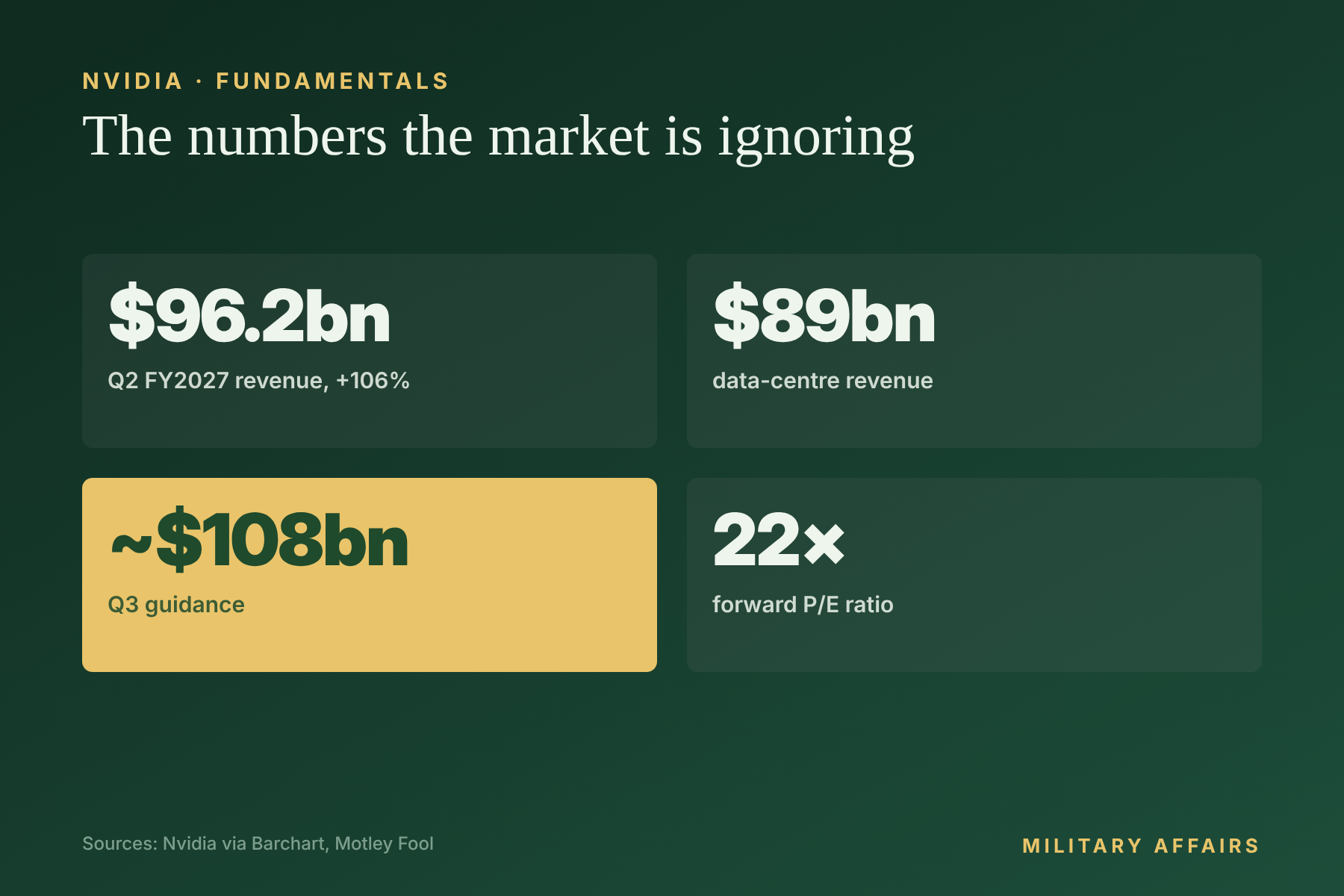
The gap between the numbers and the price is the price of risk. The market is no longer valuing earnings alone but three unanswered questions: will Huang stay at the helm, will Washington close the Chinese channel, and will the new Congress slow data-centre construction? Analyst Dan Ives estimates that Nvidia without Huang would be worth 25 to 30 per cent less. Investor Tim Ghriskey asked the question being heard across the market: "If he's replaced, who's he replaced with?"
What comes next: November 17 and 18
Two dates, back to back, will set the direction. Nvidia reports results after the market close on November 17, and a day later Congress expects Huang. Between them is macroeconomic pressure: October inflation came in above expectations, and the market sees the probability of a December rate hike at more than 80 per cent.
These are the possible scenarios:
- Stabilisation. Results and guidance clearly above expectations, and no new findings from the board inquiry. The company recovers part of its losses, but a lasting "key-person discount" remains.
- Prolonged pressure. The numbers are good, but the investigation widens into Congress and the FBI. A Motley Fool analyst warns that merely meeting guidance "would probably provoke a bearish response".
- A break. Weaker guidance, tighter exports to China, or a finding that calls Huang's position into question. That would be the first serious repricing of the AI sector since the boom began.
Assessment
Nvidia is no longer just a technology company but a strategic actor, and this crisis shows that better than any export rule. Its product has become a national-security category, its chief executive an interlocutor of the president, and his private life the subject of an intelligence assessment. Since November 4 the market has concluded that Nvidia's greatest risk is not its competitors but its dependence on one man and one government. Results on November 17 can restore confidence in the numbers. Confidence in governance, however, will only come back through investigations, and the market has no say over those.
Update, November 12
On November 11 the Wall Street Journal reported that Nvidia's board was preparing to remove Huang, and Reuters that the board met that day to decide his future. The New York Times and the Financial Times, citing unnamed sources, also reported an unconfirmed claim of a relationship between Huang and a subordinate vice-president of the company. The stock rose about three per cent in regular trading and fell more than eight per cent after the close. Republican Senator Kevin Cramer called on Huang to step down. By the morning of November 12 no board decision had been announced. The "break" scenario in this analysis has thus become a real possibility even before results on November 17.
Update, evening of November 12
Jensen Huang resigned on November 12 as chief executive and board member, effective immediately. CFO Colette Kress is interim chief executive, and Harvey C. Jones was named the board's first-ever chair. The stock fell as much as 14.3 per cent during the day, to $148.80, before recovering to around $165. The "break" scenario in this analysis has thus materialised before the November 17 results, which remain on schedule.
Sources and references
- I.Reuters via The StarNvidia selloff deepens, adding to AI jitters🔗 https://www.thestar.com.my/tech/tech-news/2026/11/11/nvidia-selloff-deepens-adding-to-ai-jitters
- II.Reuters via Star-AdvertiserWall Street rallies after last week's AI rout; Nvidia falls🔗 https://www.staradvertiser.com/2026/11/09/breaking-news/wall-street-rallies-after-last-weeks-ai-rout-nvidia-falls/
- III.Al JazeeraNvidia spy scandal fuels debate over chip exports to China🔗 https://www.aljazeera.com/economy/2026/11/10/nvidia-spy-scandal-fuels-debate-over-chip-exports-to-china
- IV.Decrypt via Yahoo FinanceNvidia erases 2026 gains as Republicans threaten Jensen Huang with subpoena🔗 https://finance.yahoo.com/markets/stocks/articles/nvidia-erases-2026-gains-republicans-204550552.html
- V.
- VI.ABC NewsHouse Republicans consider issuing subpoena to Nvidia CEO🔗 https://abcnews.com/Politics/house-republicans-issuing-subpoena-nvidia-ceo-jensen-huang/story?id=138022782
- VII.Tom's HardwareTrump says the FBI is investigating; Nvidia accused of intervening in Megaspeed probe🔗 https://www.tomshardware.com/tech-industry/policy/president-trump-says-the-fbi-is-investigating-jensen-huangs-affair-nvidia-also-accused-of-intervening-in-megaspeed-chip-smuggling-investigation
- VIII.NBC NewsTrump says FBI is investigating Huang's relationship with alleged Chinese spy🔗 https://www.nbcnews.com/business/corporations/trump-fbi-probe-nvidia-jensen-huang-spy-rcna608439
- IX.Motley FoolNov. 5: Nvidia slides on AI chip selloff🔗 https://www.fool.com/coverage/stock-market-today/2026/11/05/stock-market-today-nov-5-nvidia-slides-on-ai-chip-selloff-as-election-uncertainty-weighs/
- X.Motley FoolThe AI selloff is getting worse🔗 https://www.fool.com/investing/2026/11/05/the-ai-selloff-is-getting-worse-nvidia-dell-and-data-center-stocks-are-plunging-hard-is-it-time-to-buy-the-dip/
- XI.Motley FoolNvidia investors need to be paying attention on Nov. 17🔗 https://www.fool.com/investing/2026/11/05/stock-investors-need-to-be-paying-attention-on-dat/
- XII.Barchart via Yahoo FinanceNvidia is now down for the year after a sharp selloff🔗 https://finance.yahoo.com/markets/stocks/articles/nvidia-now-down-sharp-selloff-143929624.html
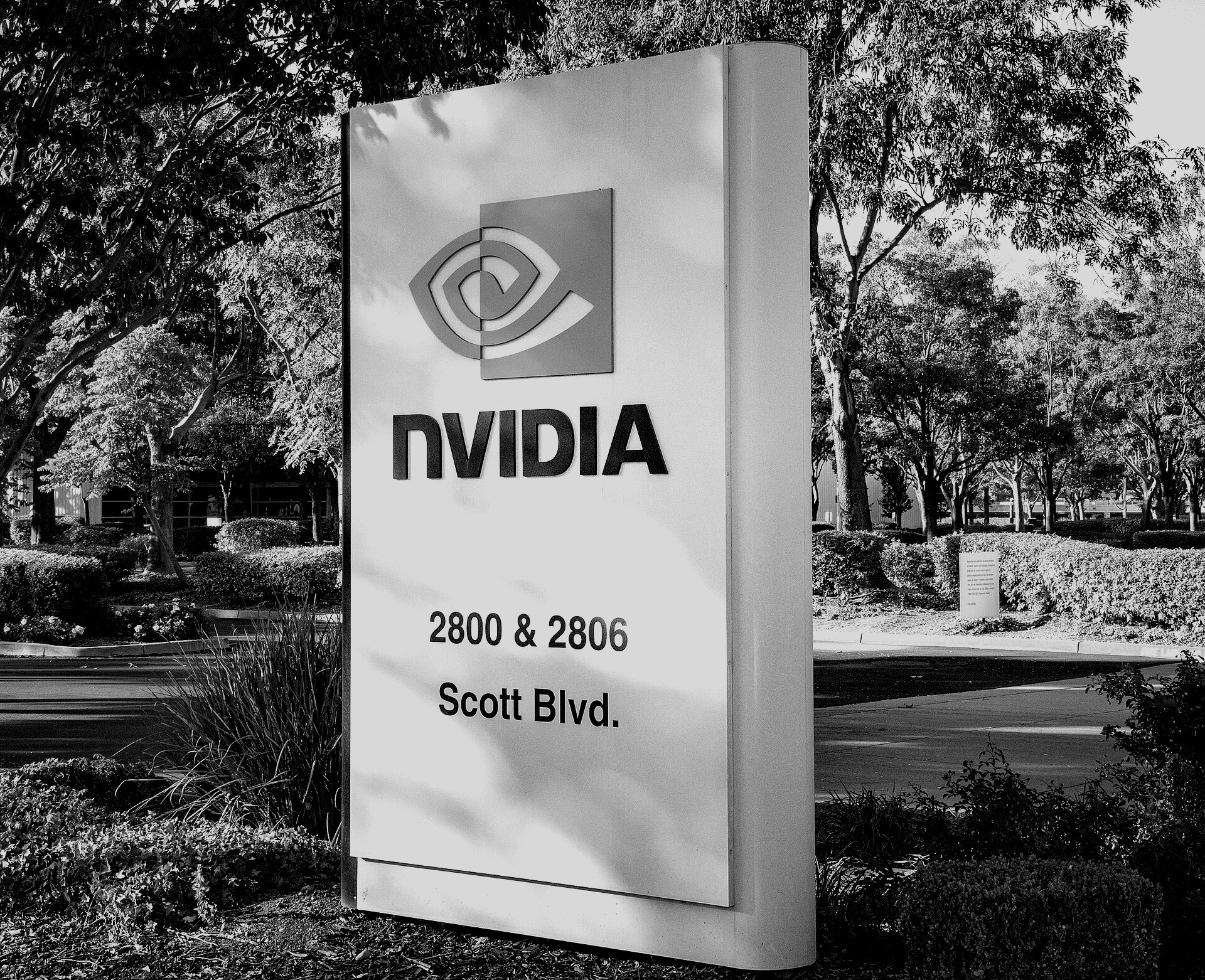
- XIII.Wikimedia CommonsNVIDIA Headquarters (Coolcaesar, CC BY-SA 4.0)🔗 https://commons.wikimedia.org/wiki/File:NVIDIA_Headquarters.jpg
- XIV.Wikimedia CommonsNvidia sign (Will Buckner, CC BY 2.0)🔗 https://commons.wikimedia.org/wiki/File:Nvidia_sign.jpg
Keep reading
Selected long reads to continue with.
 LONG READ
Shenzhen: the first Trump–Xi–Putin meeting and the limits of the big three
 LONG READ
Dodik at Mar-a-Lago: a photo, messages and the limits of lobbying
 LONG READ
Referendum at the gas pump: how the war with Iran cost Trump Congress
 LONG READ
Comments 0
No comments yet.