Nobel Prize in Physics to Francis Halzen, father of the IceCube observatory at the South Pole
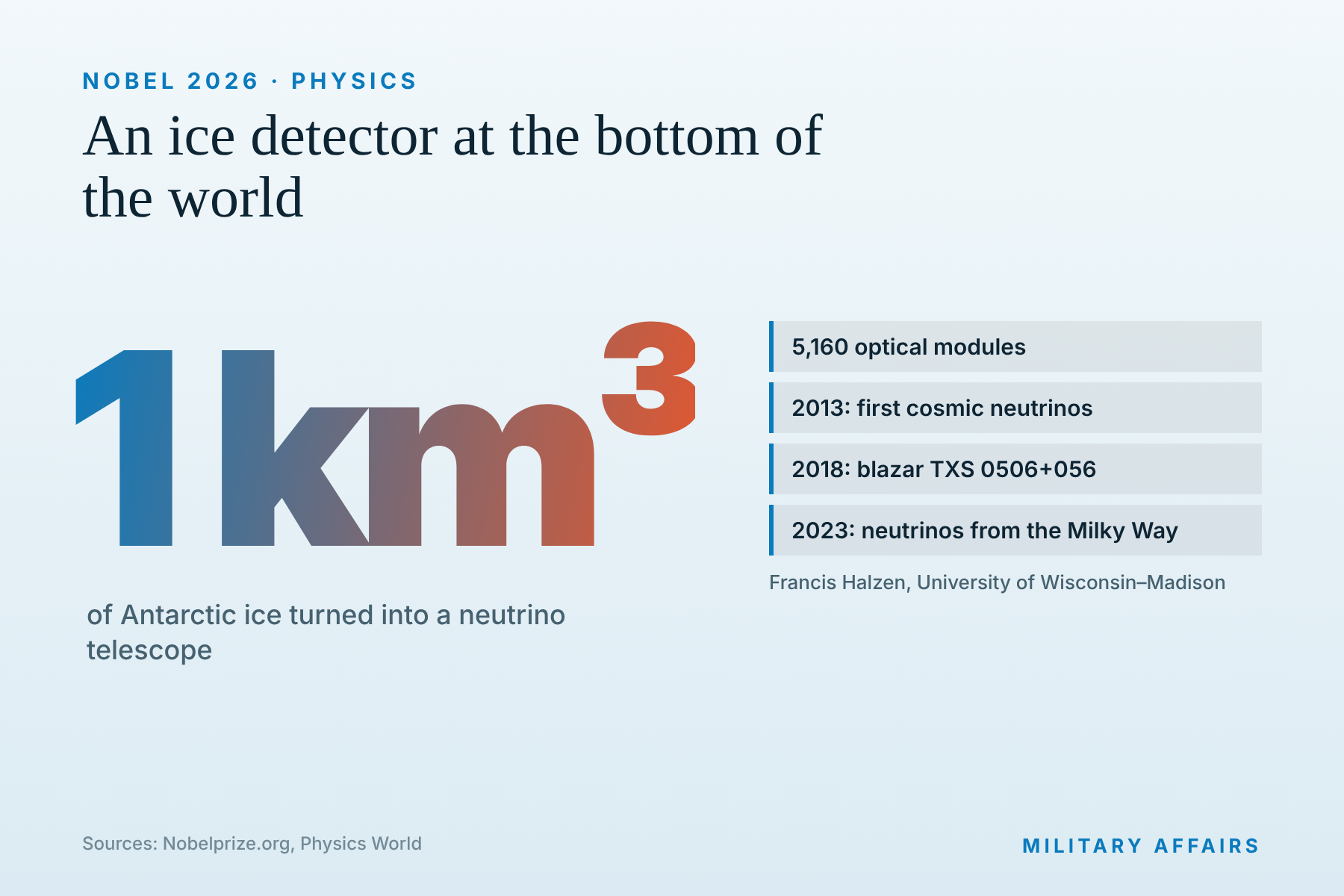
The Royal Swedish Academy of Sciences on October 6 awarded the Nobel Prize in Physics to Francis Halzen "for decisive contributions to the IceCube Neutrino Observatory and the discovery of high-energy neutrinos of astrophysical origin".
Halzen, born in 1944 in Tienen, Belgium, is a professor at the University of Wisconsin–Madison and IceCube's principal investigator. In 1988 he proposed catching neutrinos in South Pole ice: when a neutrino strikes an atomic nucleus it gives off a flash of light that sensors in the clear ice can track.
A new kind of astronomy
IceCube fills a cubic kilometre of ice, with 5,160 optical modules on 86 strings, according to Physics World. Neutrinos reach us without changing direction or losing energy, so they carry information about cosmic particle accelerators reaching energies up to a million times higher than laboratories on Earth.
The observatory found the first evidence of high-energy cosmic neutrinos in 2013, linked them to the blazar TXS 0506+056 in 2018, identified the galaxy NGC 1068 as a source in 2022 and showed in 2023 that the Milky Way emits them too. Halzen's vision "has paved the way for a new kind of astronomy", said Nobel Committee chair Mark Pearce.
Sources and references
- I.Nobelprize.orgNobel Prize in Physics 2026, press release🔗 https://www.nobelprize.org/prizes/physics/2026/press-release/
- II.Physics WorldFrancis Halzen wins Nobel Prize in Physics🔗 https://physicsworld.com/a/francis-halzen-wins-nobel-prize-in-physics/
Keep reading
Selected long reads to continue with.
 LONG READ
Referendum at the gas pump: how the war with Iran cost Trump Congress
 LONG READ
The Baltic “NATO lake” and the escalation trap: how hybrid war is nearing the threshold of open conflict
 LONG READ
A siege that endures: Mali between a jihadist blockade and Russian support
 LONG READ
Comments 0
No comments yet.