Referendum at the gas pump: how the war with Iran cost Trump Congress
Republicans went into the November 3 elections holding 53 of the 100 Senate seats and 218 seats in the House of Representatives, against 214 for the Democrats. According to projections by CBS, CNN and NBC, by the morning of November 4 they had lost both chambers. What proved decisive was not only the size of the swing but also where it happened.
In Texas, James Talarico defeated Ken Paxton to become the first Democrat elected to the Senate from the state since 1988. In Kansas, Adam Hamilton beat Senator Roger Marshall, a result the state had not seen since 1932. Sherrod Brown returned to the Senate by defeating Jon Husted in Ohio. Josh Turek beat Ashley Hinson in Iowa, Roy Cooper beat Michael Whatley in North Carolina, and Annie Andrews beat Darline Graham in South Carolina, who had been appointed to the seat of her late brother, Lindsey Graham. In Maine, Susan Collins, one of the last institutions of moderate Republicanism, conceded defeat to Troy Jackson.
The Democrats held every key seat they were defending: Georgia (Jon Ossoff), Michigan (Abdul El-Sayed), New Hampshire (Chris Pappas), Minnesota (Peggy Flanagan) and Virginia (Mark Warner). Republicans kept Florida and Nebraska, while at the time of writing Alaska and Mississippi were still too close to call.
At the gubernatorial level the picture is starker still. Gina Hinojosa unseated Greg Abbott in Texas, Amy Acton defeated Vivek Ramaswamy in Ohio, and Keisha Lance Bottoms became Georgia's first Democratic governor since 1998.
Why this is not an ordinary "punishment" midterm
American political science has long known that the party in power loses on average about 25 House seats in midterm elections. That is why any defeat for the governing party is easily written off as a historical regularity. This time that explanation does not hold, for three reasons.
First, the map was rigged in the Republicans' favour, and it still did not help. After the Supreme Court's ruling in Louisiana v. Callais, which weakened part of the Voting Rights Act in April, several Southern states redrew their districts mid-cycle. According to a New York Times estimate, this could have handed Republicans as many as 12 seats. The Democrats nonetheless won a majority, including at least three Florida districts drawn precisely for Republicans. When a party wins despite a structural obstacle of that magnitude, the votes measure not just mood but anger.
Second, the swing was strongest where Trump was strongest in 2024. According to a New York Times analysis, South Carolina counties that Trump carried shifted left by an average of about 21 percentage points. Kansas and Texas are not swing states but core Republican states, and it is precisely they that fell.
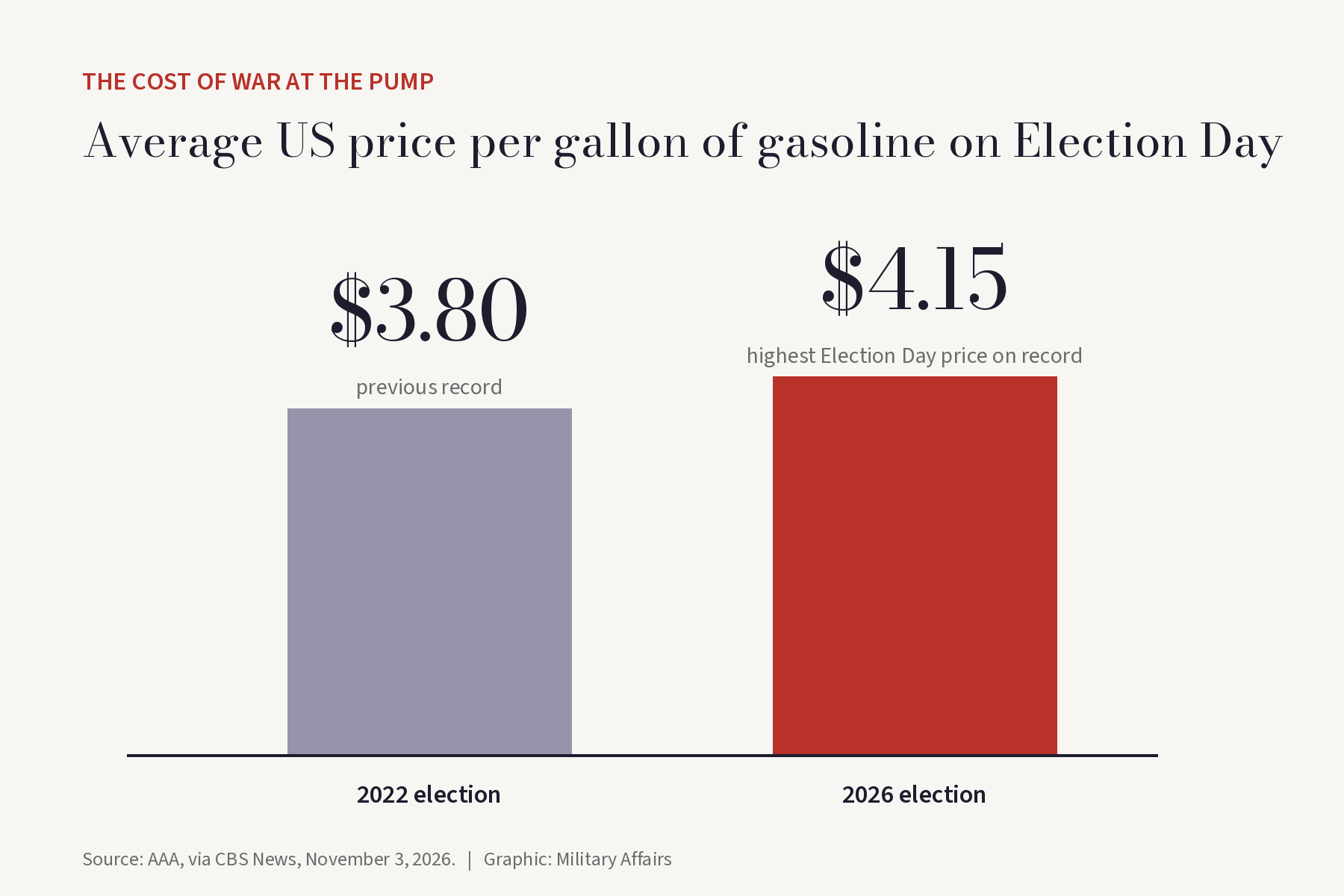
Third, and most important, the elections had a clear foreign-policy cause. The United States and Israel attacked Iran on February 28, 2026, in Operation "Epic Fury". A war that was supposed to be short had lasted eight months by election day. The average price of a gallon of gasoline on election day was $4.15, which, according to AAA, is the highest election-day price ever recorded (the previous record, from 2022, was $3.80).
The Strait of Hormuz as an electoral district
Here lies the thesis of this analysis. Classical theory holds that Americans punish foreign policy only when their soldiers come home in coffins: Korea in 1952, Vietnam in 1968, Iraq in 2006. The 2026 elections reveal a new mechanism: war reaches the electorate not through casualties but through prices.
When Iran blocked the Strait of Hormuz, through which a large share of the world's oil trade passes, the war travelled from the Middle East into every American kitchen and to every gas station. Combined with tariffs, which critics say were already pushing up inflation, this created a double squeeze on the cost of living. According to exit polls, about three-quarters of voters are dissatisfied with the direction of the country, and Trump's approval rating fell to 38 percent, which could be a record low for a president in a midterm election. Six in ten voters said Trump was a factor in their vote for the House.

The strategic consequence goes beyond American domestic politics. An adversary that controls the chokepoints of global energy has gained an indirect vote in American elections. Tehran did not have to win a single battle. It was enough for the war to last long enough and cost enough. For any future administration the lesson is an uncomfortable one: wars of choice in energy-sensitive regions now have an electoral shelf life, measured by the price of a gallon, not the number of dead.
Some Republicans saw this too. Mike Rogers in Michigan and Ashley Hinson in Iowa called for an end to the war towards the close of the campaign. Iowa congressmen Zach Nunn and Mariannette Miller-Meeks changed their position and voted to limit the president's war powers. All four lost.
Congress's three levers, and why none is enough
From January 2027 the Democratic majority gains three constitutional instruments vis-à-vis the White House. It is important to understand both what each can do and where its limits lie.
1. The mandate (war powers). The House has already passed several resolutions limiting military operations against Iran, and the Senate passed its own version in June. The White House calls them "symbolic". Gregory Meeks, the likely new chairman of the Foreign Affairs Committee, has threatened legal action to enforce those resolutions. The limit of this lever is the veto: according to Brookings, Democrats will most likely not have the two-thirds majority needed to override it. Trump said as much himself before the elections, announcing that he would veto everything a Democratic Congress sent him.
2. Money (the budget). This is traditionally Congress's strongest weapon, but in this case it has been weakened in advance. The tax and spending law of July 2025 granted the Department of Defense $156 billion that can be spent until September 2029, with broader authorities than the regular budget. This is, in essence, a prepaid war: a reserve that allows the Pentagon to conduct operations independently of annual budget battles. In addition, the defense budget request for fiscal 2027 stands at $1.5 trillion, about 66 percent more than a year earlier, and has not yet been passed. Democrats can slow that growth, but they cannot shut a tap that is already open.
3. Light (oversight and subpoenas). This is the lever the Democrats control completely, with no veto and no two-thirds majority required. Committee chairs can issue subpoenas and launch investigations. Oversight does not stop a war, but it raises its political cost and exposes its economics.
The dangerous window: November 4 to January 3
The most important time marker in this analysis is not 2028 but the next sixty or so days. The new Congress takes office on January 3, 2027. Until then Republicans still hold both chambers, and the president has no electoral reason for restraint.
The signals are clear. On October 23 Trump said: "Maybe we'll do one more little 'Epic Fury' operation." Asked about new strikes after the elections, he replied on October 28: "I can't say for sure, but anything is possible." According to the Associated Press, US officials have warned allies in the Middle East that attacks could resume after November 3, that a new operation could last several days, and that Iran could retaliate with strikes on energy infrastructure in the Gulf. On October 31 Secretary of State Rubio said no decision had been made and that the president prefers a diplomatic solution.

At the same time, CSIS analysts warn that in the remaining weeks Republicans could use the budget reconciliation procedure (reconciliation), which requires only a simple majority in the Senate, to lock in additional defense funding before the majority changes hands.
Strategically, this is a classic closing window: an actor who knows his room for manoeuvre is narrowing has an incentive to act before the narrowing takes place. That is why the "lame duck" period is objectively the riskiest phase of the Iran crisis since February. Anyone following the Gulf, the oil market or the security of shipping routes should watch the next sixty days more closely than any period since the war began.
A diplomatic channel exists, but it is stuck. Qatar has proposed a seven-day sequence of confidence-building measures ahead of comprehensive negotiations. Iran opposes this, and it is disputed whether sanctions should be lifted before or after the nuclear issue. Tehran has reportedly offered to reopen the Strait of Hormuz within two days if Washington accepts its demands, including the withdrawal of new sanctions and a reduction of the US military presence in the region. The election result strengthens Iran's position in that bargaining, because Tehran now knows that the American president is negotiating with a shrinking domestic mandate.
Ukraine, Russia and NATO: Europe gains time
For the European security environment, including the Balkans, the consequences may be more lasting than those in the Middle East.
Congressman Jim Himes, the top Democrat on the Intelligence Committee, said in October at the Warsaw Security Forum that under Democratic control of both chambers, aid packages for Ukraine would pass "not in nine months, but in nine days, or at most nine weeks". He also said Democrats would use budget negotiations with Trump as leverage for "a much more affirmative and consistent policy of support for Ukraine".
This matters because of the PURL mechanism (Prioritised Ukraine Requirements List), through which European allies finance purchases of American weapons for Ukraine while NATO coordinates deliveries. The system assumes that Washington is willing to sell the equipment. According to reports, the administration threatened to disrupt that supply chain in order to force Kyiv to halt deep strikes on Russian energy infrastructure. A Congress with a Democratic majority cannot directly conduct foreign policy, but it can protect such mechanisms politically and through the budget.
Analysts also expect pressure for tougher sanctions on Russia. Trump has already drawn criticism from both parties for temporarily lifting restrictions on Russian diesel exports. A stabilisation of American engagement in NATO is also expected.
For European right-wing movements in Germany and France, which drew part of their strength from ties to the Trump administration, this is the first serious signal that the "MAGA International" is not a permanent state of American politics.
Trump's reaction: a conciliatory tone, an unchanged message
Trump told CBS: "My message is congratulations to the Democrats," adding that he looked forward to working with them. Asked whether he accepted the results, he replied: "Yes, of course I accept them." At the same time, he wrote on Truth Social that he "was not on the ballot" and that otherwise Republicans would have won "BIGLY".
That duality, institutional acknowledgement coupled with a narrative refusal of responsibility, heralds the style of the next two years: formal cooperation and constant conflict over interpretation.
What comes next
Political scientist Costas Panagopoulos called the results "a complete repudiation of Trump and Republican policy". His colleague Martha Johnson cautions that this is nonetheless not a clear mandate for the Democratic programme, which remains hard to define precisely. The election of Abdul El-Sayed in Michigan, the first Muslim elected to the Senate, also opens an internal question about the relationship between the party's progressive and centrist wings.
For Military Affairs readers, the key points are as follows:
- Short term (until January 3): heightened risk of new strikes on Iran and of accelerated locking-in of military funding through budget reconciliation.
- Medium term (2027): conflict over war powers and the fiscal 2027 budget, investigations, faster aid to Ukraine and pressure for sanctions on Russia.
- Long term (to 2028): a test of the thesis that war in energy-sensitive regions is punished at the pump before it is punished at the cemetery.
The November 3 elections did not end the war with Iran. But for the first time they showed how much it costs the one who started it.
Editor's note: results are given according to US media projections as of the morning of November 4, 2026. Final seat allocations will be known once counting is complete.
Sources and references
- I.CBS News2026 midterm election results: Democrats decisively win control of House and Senate🔗 https://www.cbsnews.com/live-updates/election-day-2026-midterms/
- II.Northeastern Global News2026 midterm election results: Who won the key House and Senate races?🔗 https://news.northeastern.edu/2026/11/03/midterm-election-results-analysis-2026/
- III.Al-MonitorDemocrats projected to win House as voters rebuke Trump's Iran war🔗 https://al-monitor.com/originals/2026/11/democrats-projected-win-house-voters-rebuke-trumps-iran-war
- IV.The EconomyDefense budget and Iran after the midterms🔗 https://economy.ac/news/2026/11/202611300438
- V.Breaking DefenseDemocratic midterm gains could speed US military aid to Ukraine, lawmaker says🔗 https://breakingdefense.com/2026/10/democratic-midterm-gains-could-speed-us-military-aid-to-ukraine-lawmaker-says/
- VI.ABC News / APIowa Republicans in battleground House races vote to halt the Iran war🔗 https://abcnews.com/Politics/wireStory/iowa-republicans-battleground-house-races-vote-halt-iran-136494575
- VII.Colorado PoliticsTrump threatens to 'veto everything' during a Democratic Congress🔗 https://www.coloradopolitics.com/2026/10/23/trump-threatens-to-veto-everything-during-a-democratic-congress/
Keep reading
Selected long reads to continue with.
 LONG READ
The Baltic “NATO lake” and the escalation trap: how hybrid war is nearing the threshold of open conflict
 LONG READ
A siege that endures: Mali between a jihadist blockade and Russian support
 LONG READ
The strait as leverage: Iran's strategy of attrition and the price the world pays
 LONG READ
Comments 0
No comments yet.