Homo erectus in South Africa two million years ago, 200,000 years before Dmanisi
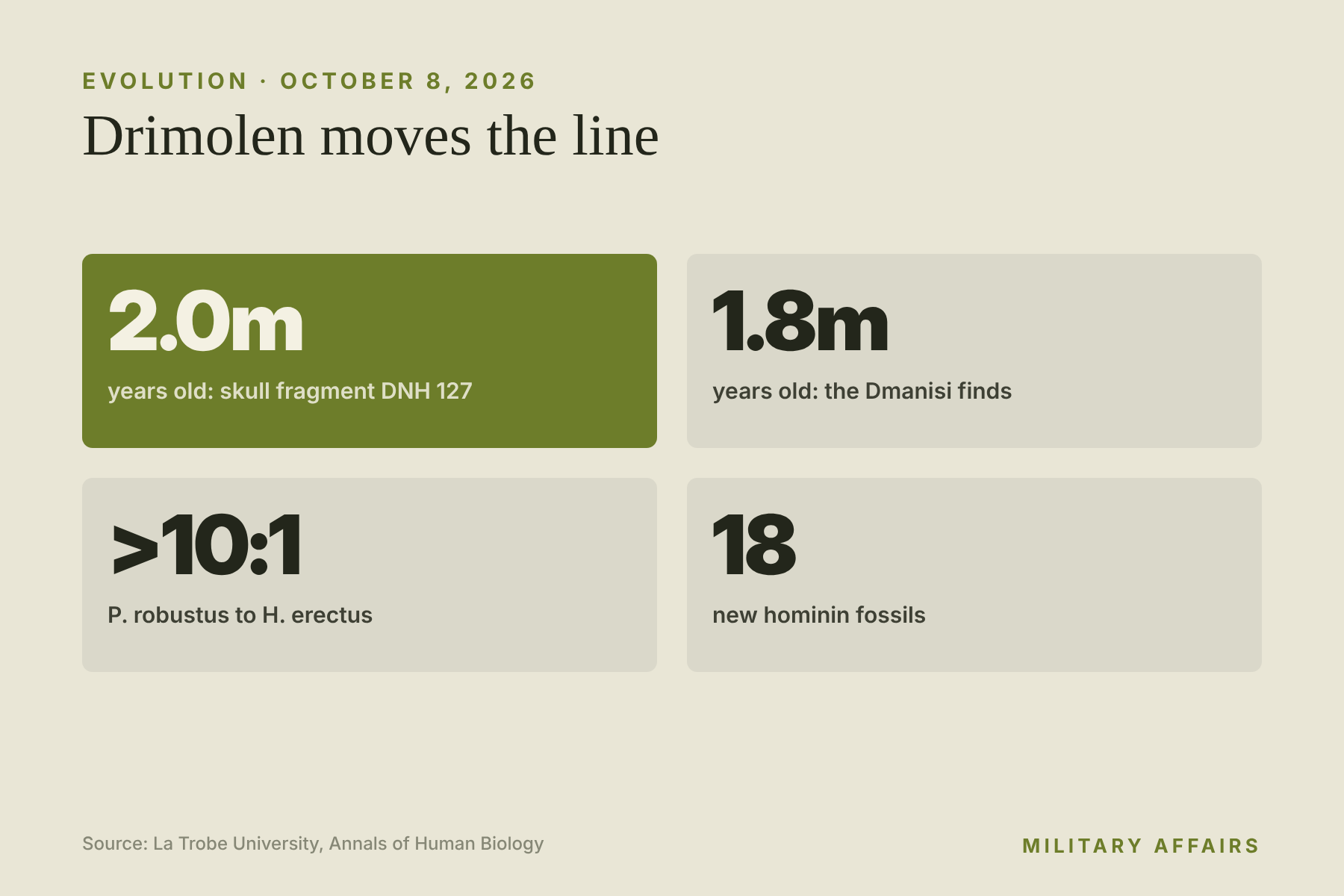
Researchers have described 18 new hominin fossils from Drimolen in South Africa's Cradle of Humankind, including a roughly two-million-year-old skull fragment of an adult Homo erectus, in a study published in Annals of Human Biology and reported by ScienceDaily on October 8.
The fragment, catalogued DNH 127, is about 200,000 years older than the adult fossils from Dmanisi in Georgia, about 1.8 million years old, which had been considered the oldest such finds.
Two evolutionary paths
At Drimolen, Paranthropus robustus, a heavy-jawed relative, outnumbered Homo erectus by more than ten to one, said Jesse Martin of La Trobe University. The two species evolved in opposite directions between 2.0 and 1.8 million years ago: Homo erectus towards a bigger brain and smaller molars, P. robustus towards bigger teeth and jaws.
Sources and references
- I.ScienceDaily / La Trobe UniversityHomo erectus at Drimolen (Annals of Human Biology, DOI 10.1080/03014460.2026.2725046)🔗 https://www.sciencedaily.com/releases/2026/10/261007042113.htm
Keep reading
Selected long reads to continue with.
 LONG READ
Referendum at the gas pump: how the war with Iran cost Trump Congress
 LONG READ
The Baltic “NATO lake” and the escalation trap: how hybrid war is nearing the threshold of open conflict
 LONG READ
A siege that endures: Mali between a jihadist blockade and Russian support
 LONG READ
Comments 0
No comments yet.