Nobel Prize in Chemistry to Kagan and Soai: how molecules choose a side
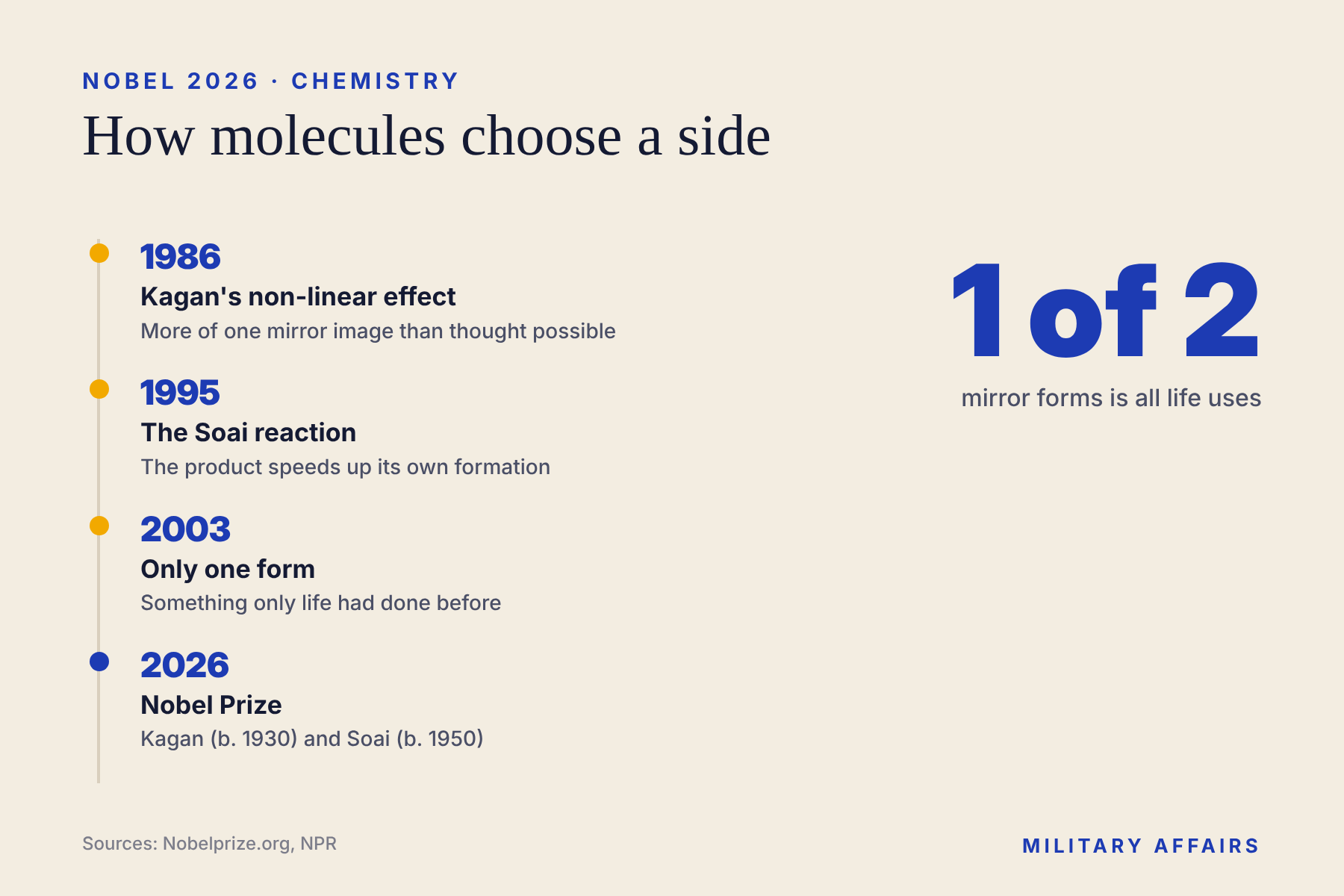
The Royal Swedish Academy of Sciences on October 7 awarded the Nobel Prize in Chemistry to Henri B. Kagan and Kenso Soai "for the discovery of non-linear effects and autocatalysis in asymmetric organic synthesis".
Life is homochiral: amino acids exist in two mirror-image forms, but only one appears in our proteins. Chemists long struggled to explain how such asymmetry arises.
Two discoveries
In 1986 Kagan discovered a non-linear effect that produced a larger excess of one mirror image than had been thought possible. In 1995 Soai described a self-accelerating, self-amplifying reaction, now called the Soai reaction, and in 2003 showed it could produce only one of the two forms, something only life itself had done before. "This is probably the coolest experiment in organic chemistry," committee member Peter Somfai said.
For medicine this matters directly, because in a drug usually only one mirror image has the desired effect. An everyday example is carvone: one form smells of mint and its mirror image of caraway.
Sources and references
- I.Nobelprize.orgNobel Prize in Chemistry 2026, press release🔗 https://www.nobelprize.org/prizes/chemistry/2026/press-release/
- II.WUNC / NPRHenri B. Kagan and Kenso Soai win Nobel Prize in chemistry🔗 https://www.wunc.org/2026-10-07/henri-b-kagan-and-kenso-soai-win-nobel-prize-in-chemistry
Keep reading
Selected long reads to continue with.
 LONG READ
Referendum at the gas pump: how the war with Iran cost Trump Congress
 LONG READ
The Baltic “NATO lake” and the escalation trap: how hybrid war is nearing the threshold of open conflict
 LONG READ
A siege that endures: Mali between a jihadist blockade and Russian support
 LONG READ
Comments 0
No comments yet.