The strait as leverage: Iran's strategy of attrition and the price the world pays
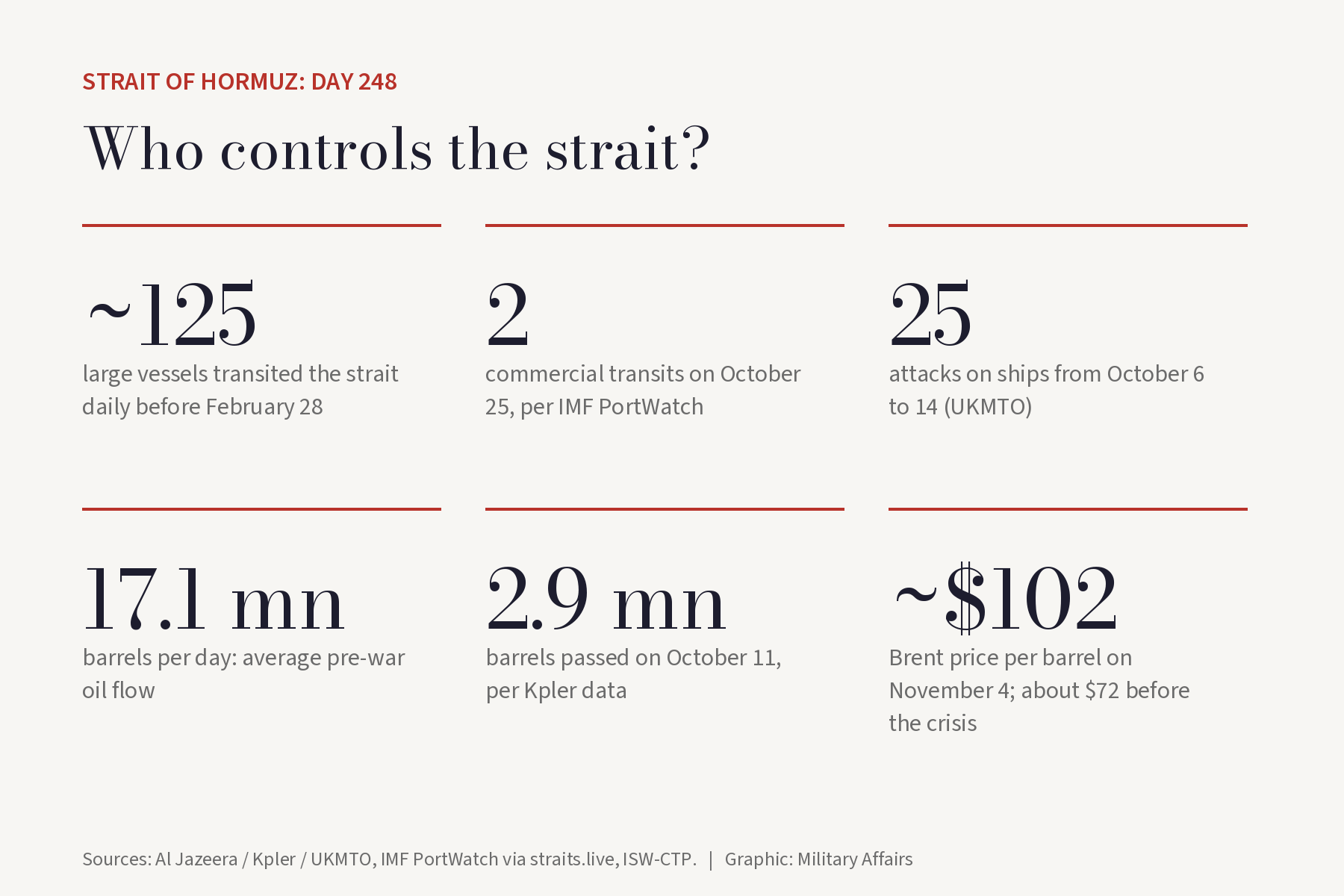
The war that the United States and Israel launched on February 28, 2026, with strikes that killed Supreme Leader Ali Khamenei, was supposed to be a short campaign. It is now entering its ninth month, and its centre of gravity is no longer Iran's nuclear programme but a narrow sea passage through which, before the war, according to Kpler data cited by Al Jazeera, some 125 large vessels and about a fifth of the world's oil and liquefied natural gas passed every day.
According to IMF PortWatch, only two commercial vessels transited the strait on October 25. Brent traded at around $102 a barrel on November 4, compared with about $72 before the crisis. Iran's Revolutionary Guard (IRGC) claimed the same day that four tankers had been destroyed by mines; no maritime authority has confirmed this.
A strategy that does not seek victory
The key to understanding Iran lies in what Tehran is actually trying to achieve. The Institute for the Study of War (ISW) and the Critical Threats Project (CTP) identify four objectives: international recognition of Iranian control over the strait, weakening America's ability and will to continue the war, restoring deterrence against the US and its regional partners, and driving a wedge between the US and Israel on one side and the Arab states on the other.
None of these objectives requires a military victory. It is enough that the strait cannot be considered safe. According to ISW, Tehran calculates that disruption to shipping and high oil prices can push Washington toward a diplomatic settlement favourable to Iran. "Iran remains the only threat to civilian shipping in the strait," ISW concluded in its November 1 report.
Chris Featherstone, an analyst at the University of York, put it precisely to Al Jazeera: the strait is not under Iranian control, but Iranian attacks are meant to show that Washington does not control it either.
The October escalation
September looked like a recovery. According to Kpler, Gulf oil flows excluding Iran recovered to more than 81 percent of pre-war levels, and crude exports from the wider Middle East exceeded pre-war volumes over a 14-day period. Then Iran changed tactics.
Kpler recorded ten tankers hit between September 28 and October 4. The UK Maritime Trade Operations centre (UKMTO) registered a further 15 attacks from October 6 to 14, 11 of them in the last four days. Flows fell from about 20.8 million barrels on October 8 to about 2.9 million on October 11. The US Navy-led Joint Maritime Information Center raised its threat assessment to "severe", the second-highest level.
An unnamed Iranian official told Reuters that one aim of the new tactics was to influence the US elections in November. The result of the November 3 elections, in which the Democrats won both chambers of Congress, shows that fuel prices have become one of the decisive factors in American domestic politics.
Two stories about the same sea
Washington and Tehran describe entirely different realities. US Central Command (CENTCOM) said that "the IRGC Navy commander has no navy" and that "US forces and regional partners clearly control the Strait of Hormuz", stating that on October 13 they had helped more than 19 million barrels of crude pass through. Iranian security official Mohsen Rezaei claims that the US, with the help of the UAE, is ferrying oil on smaller vessels to larger tankers and that Iran hits five to six such vessels every night. "You are smuggling, but the strait is under Iran's control and we manage it," he said.
Both claims are partly true. In August, according to CENTCOM commander Admiral Brad Cooper, the US cleared Iranian mines from the traffic separation scheme, and underwater drones identified more than a hundred suspected mines. But a ship that switches off its transponder and takes an "unauthorised" route, as Iran calls it, still risks being attacked. On November 3 the IRGC claimed that three tankers had struck mines for precisely that reason. ISW assesses that Iran publishes such claims to deter shipowners from bypassing Iranian transit procedures.
The risk of direct confrontation
The most dangerous development is not at sea but in the air. According to the Wall Street Journal, on November 2 the IRGC fired a surface-to-air missile at a US fighter jet near Qeshm Island, and the aircraft returned fire. In August a similar missile was fired at an F-35 but, according to a US official, did not come anywhere near it. ISW warns that repeated launches could force the US to commit more aircraft and electronic warfare support, and create domestic political pressure. On November 4 Trump confirmed a US strike on an Iranian air defence facility.
The war is also spreading through proxies. According to ISW, Iraq reportedly deployed four army brigades to Basra province on October 31 to prevent Iran-backed militias from attacking Kuwait in the event of a US strike. Meanwhile, the Houthis are advancing in Yemen's Lahij province, towards Aden, and targeting Saudi territory.
Diplomacy on hold
Iran says the US has accepted some of its seven conditions for reopening the strait and ending the war, but that the American response is "insufficient". On November 3 Tehran said the strait could be reopened within 48 hours if the US met its conditions, and a day later called the American response "unconvincing". Previous frameworks, including the Islamabad memorandum of June that ended the double blockade, collapsed when Iran again attacked merchant ships on July 8.
For Europe and the Balkans, the consequences are not abstract. The cost of energy, insurance and transport is passed on to every petrol pump and every electricity bill. The war over the strait shows that in the 21st century one does not need to control the sea in order to control its price. It is enough to prove that no one else can make it safe.
Figures on transits and attacks come from different sources (Kpler, UKMTO, IMF PortWatch) that use different methodologies and are therefore not directly comparable.
Sources and references
- I.Institute for the Study of War / Critical ThreatsIran Update, November 3, 2026🔗 https://www.criticalthreats.org/analysis/iran-update-november-3-2026
- II.Institute for the Study of War / Critical ThreatsIran Update, November 1, 2026🔗 https://www.criticalthreats.org/analysis/iran-update-november-1-2026
- III.Al JazeeraIran steps up Hormuz surveillance: Attacks soar, oil flows crash again🔗 https://www.aljazeera.com/news/2026/10/14/iran-steps-up-hormuz-surveillance-attacks-soar-oil-flows-crash-again
- IV.Straits.liveStrait of Hormuz status (IMF PortWatch, Brent)🔗 https://straits.live/
- V.Wikipedia2026 Iran war🔗 https://en.wikipedia.org/wiki/2026_Iran_war
Keep reading
Selected long reads to continue with.
 LONG READ
Referendum at the gas pump: how the war with Iran cost Trump Congress
 LONG READ
The Baltic “NATO lake” and the escalation trap: how hybrid war is nearing the threshold of open conflict
 LONG READ
A siege that endures: Mali between a jihadist blockade and Russian support
 LONG READ
Comments 0
No comments yet.