Bosnia and Herzegovina after the elections: same parties, new patrons and an empty High Representative's chair
The Central Election Commission of BiH on November 3 in Sarajevo certified the results of the general elections held on October 4. This starts the clock on the statutory deadlines for forming governments at all levels. At first glance, the outcome is familiar: the BiH Presidency comprises Denis Bećirović (SDP), Željka Cvijanović (SNSD) and new member Darijana Filipović (HDZ BiH), and the largest parties are the same as four years ago.
But behind the continuity on the ballot papers lies a change in the environment that could matter more in the coming term than the results themselves: the international framework that has shaped Bosnian politics for three decades has never been this unstable.
What the ballot boxes showed
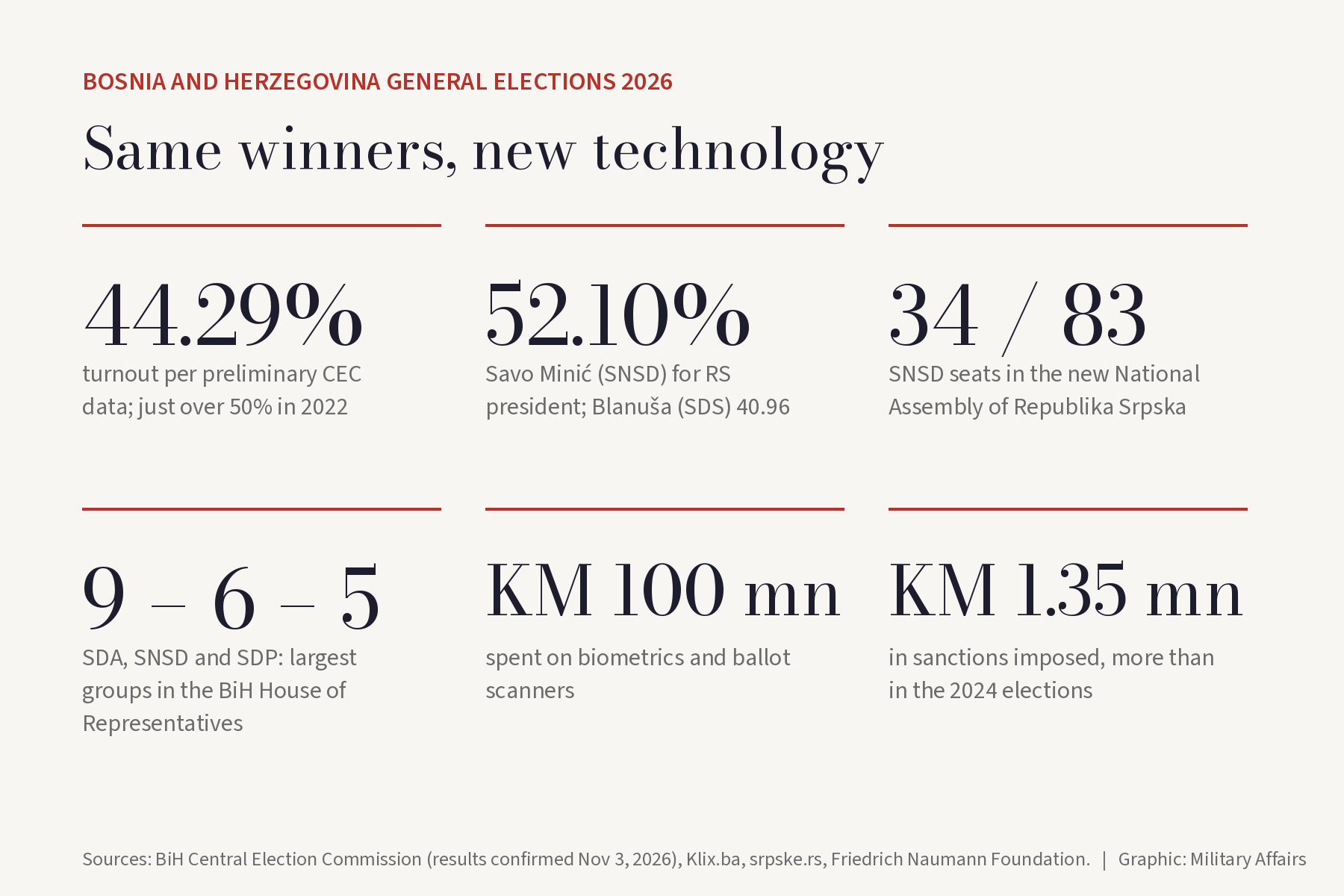
According to the certified results, Savo Minić (SNSD) was elected President of Republika Srpska with 52.10 percent of the vote, ahead of Branko Blanuša (SDS) with 40.96 percent. Ramiz Salkić (SDA) and Igor Balukčić (HDZ 1990) were elected vice-presidents. Milorad Dodik, the SNSD leader, called the result “unexpectedly high” on election night; a week before the vote, according to Reuters, he met Vladimir Putin in Moscow.
In the National Assembly of Republika Srpska, the SNSD holds 34 of 83 seats, Draško Stanivuković's Sigurna Srpska Movement 12 and the SDS 10. According to the portal srpske.rs, the SNSD-led ruling coalition commands 54 seats; whether it reaches the two-thirds majority of 56 will become clear at the constituent session.
In the House of Representatives of the BiH Parliamentary Assembly, the largest caucuses are the SDA with nine seats, the SNSD with six and the SDP with five, while the coalition around HDZ BiH has four. In the House of Representatives of the Federation Parliament, the SDA is again the strongest with 31 of 98 seats, ahead of the SDP with 16 and the coalition around HDZ BiH with 15. According to an analysis by the Friedrich Naumann Foundation, the SDA is the strongest single party but did not win the Bosniak seat in the Presidency.
The biggest loser among the civic parties is Naša stranka. According to the same analysis, at state level it fell from about 49,000 votes in 2022 to about 30,000, and in Sarajevo Canton, its traditional stronghold, from about 25,000 to about 11,500.
Better technology, weaker trust
The paradox of these elections is that the process was more credible than ever, yet turnout was lower than ever. According to preliminary CEC data, 44.29 percent of voters cast ballots, while turnout in 2022 was slightly above 50 percent; the Naumann Foundation notes that the decline was most pronounced in the Federation. A September survey cited in the same analysis found that 74 percent of citizens believe elections in BiH are neither free nor fair, and roughly one in ten voters said they had witnessed vote-buying or another form of fraud.
CEC President Jovan Kalaba said the commission had “successfully risen to the task in one of the most challenging election years”. According to most observers, the new technology enabled faster and more accurate counting. What it did not change was the political offer.
An empty chair at the OHR
The most important change happened not at the elections but in the Office of the High Representative. Christian Schmidt announced his resignation on May 11, 2026. Officially, the decision was personal; according to reports cited by the International Centre for Defence and Security (ICDS) in Tallinn, the Trump administration pressed him to leave. Since July 1, the duties have been performed in an acting capacity, with the same powers, by US diplomat Louis Crishock, previously Principal Deputy High Representative and Brčko District Supervisor.
The Peace Implementation Council (PIC) has yet to agree on a successor. According to the ICDS, the US backs Italian diplomat Antonio Zanardi Landi, while the European majority and the United Kingdom back French diplomat René Troccaz. The dispute is not about names but about the mandate: Washington favors less oversight and economic goals, while the EU wants to preserve the office's normative authority.
New patrons, new logic
The shift in US policy is visible elsewhere too. In October 2025 the US Treasury lifted sanctions on Milorad Dodik, members of his family and associated persons and companies. At the same time, Washington is strongly promoting the Southern Interconnection gas pipeline, which would link BiH with Croatia and enable imports of American liquefied natural gas.
The project, which the EU has supported for years, has, however, acquired an unexpected promoter. According to Oilprice, as reported by Baystreet, a law was amended in April 2026 so that BH Gas's role would be taken over by AAFS, a company registered in Wyoming a few months earlier, whose acknowledged owners are Jesse Binnall, Trump's personal lawyer, and Joe Flynn, brother of former national security adviser Michael Flynn. No tender was held. The EU supports the pipeline itself but, according to the same source, objects to the non-transparent procedure; according to available reports, Schmidt parted ways with Washington precisely over the way the project was awarded. Republika Srpska approved the project in April, but is in parallel developing its own Eastern Interconnection towards Serbia, worth about 500 million euros, which would preserve the link to Russian gas.
What comes next
According to the Naumann Foundation, the key negotiations in the Federation will begin only after the cantonal assemblies elect delegates to the House of Peoples, because only then can the President and Vice-Presidents of the Federation, and subsequently the government, be elected. Since the same parties are negotiating at the cantonal, entity and state levels, the coalitions will be mutually conditioned.
For the EU, the deadline is closer than it seems. BiH has been a candidate since 2022, and the opening of negotiations was approved in 2024, but talks have not begun. According to the ICDS, the country has no agreed chief negotiator or Reform Agenda and has not received pre-financing from the Growth Plan; if leaders fail to reach agreement by December 2026, Brussels could redirect the funds to more advanced Western Balkan countries.
The elections thus confirmed what was already known about the domestic scene. The real question of the coming term is a different one: who, and with what aims, will be the external arbiter of the Dayton order, if there is one at all.
Claims about the circumstances of the High Representative's resignation and about the ownership structure of AAFS come from media and analytical sources and are not the subject of court rulings.
Sources and references
- I.Klix.baFinal allocation of seats at all levels determined: election results certified🔗 https://www.klix.ba/vijesti/bih/utvrdena-konacna-raspodjela-mandata-na-svim-nivoima-potvrdeni-rezultati-izbora-slijedi-formiranje-vlasti/261103081
- II.Klix.ba2026 General Election results: President and Vice-Presidents of Republika Srpska🔗 https://izbori.klix.ba/opci-izbori-2026/predsjednik-i-potpredsjednici-republike-srpske
- III.Srpske.rsBiH CEC certifies election results, Minić President of Srpska🔗 https://srpske.rs/vesti/svet/2026/11/03/cik-bih-potvrdio-rezultate-izbora-minic-predsednik-srpske-cvijanovic-srpski-clan
- IV.Friedrich Naumann FoundationBosnia and Herzegovina: General Elections 2026: New Technology, Familiar Outcomes🔗 https://www.freiheit.org/western-balkans/general-elections-2026-new-technology-familiar-outcomes
- V.The Spokesman-Review / ReutersLeftist and nationalists lead in election for Bosnia's tripartite presidency🔗 https://www.spokesman.com/stories/2026/oct/03/leftist-and-nationalists-lead-in-election-for-bosn/
- VI.International Centre for Defence and Security (ICDS)Interregnum in Bosnia and Herzegovina🔗 https://icds.ee/en/interregnum-in-bosnia-and-herzegovina/
- VII.Baystreet.ca / OilpriceTrump's Bosnia Power Play Puts an Opaque Energy Deal at the Center🔗 https://www.baystreet.ca/amp/articles/Commodities.aspx?articleid=123060
Keep reading
Selected long reads to continue with.
 LONG READ
Referendum at the gas pump: how the war with Iran cost Trump Congress
 LONG READ
The Baltic “NATO lake” and the escalation trap: how hybrid war is nearing the threshold of open conflict
 LONG READ
A siege that endures: Mali between a jihadist blockade and Russian support
 LONG READ
Comments 0
No comments yet.