The illusion of initiative: why the Kremlin negotiates as if it is winning while the front stands still
When special envoy Steve Witkoff presented Ukrainian and European proposals from the Oslo talks to Vladimir Putin in St Petersburg on October 21, the response was brief. Putin judged that they contained “little that was useful”, and his adviser Yuri Ushakov said the Russian president had given Witkoff an “objective picture” in which Russia holds “full strategic initiative”. Kremlin spokesman Dmitry Peskov added that Russia needs “peace, not a ceasefire”.
That formulation is the key to understanding the upcoming trilateral talks in Abu Dhabi on November 10 and 11. Moscow is not negotiating over the front line but over capitulation: the Institute for the Study of War (ISW) assesses that the Kremlin rejects any proposal that does not entail Ukraine’s “full capitulation”. The problem for the Kremlin is that the battlefield increasingly fails to justify that position.
What the map shows
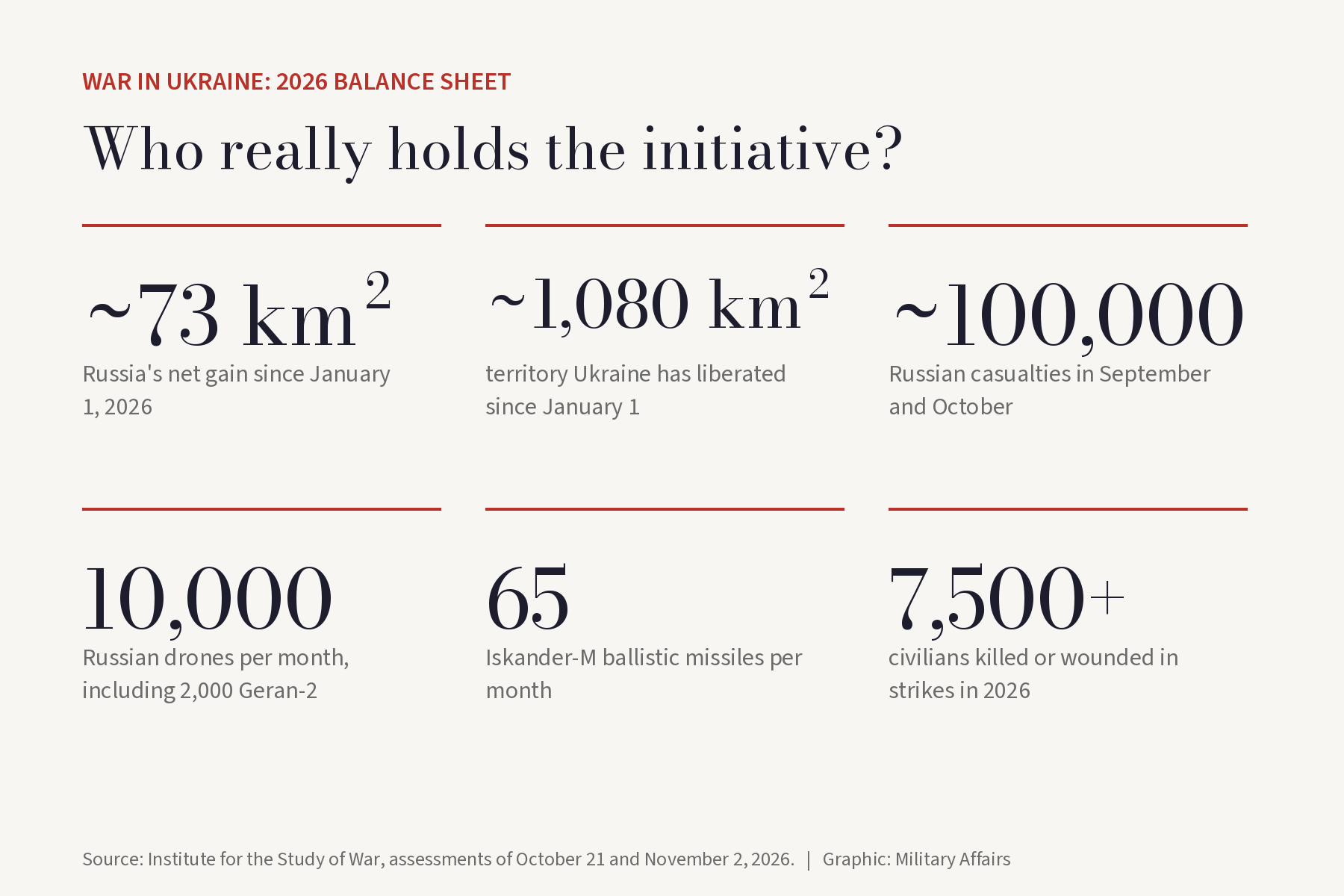
According to ISW’s assessment of October 21, Russia has made a net gain of only about 73 square kilometers since January 1, 2026, while at the same time it has suffered a net loss of about 73 square kilometers since September 1. Ukraine has liberated about 1,080 square kilometers since the start of the year. Operation “Vivaldi” on the Lyman axis has liberated at least 277 square kilometers and, according to ISW, defeated the northern pincer of Russia’s planned encirclement of Donetsk Oblast.
In its November 2 assessment, ISW goes a step further: Russian forces have recorded “negative territorial gains” over the past two months, with almost 100,000 casualties in September and October. Operation “Vivaldi”, it says, inflicted an “operational defeat” on the Russian campaign plan against Ukraine’s “Fortress Belt”, although the Russian command has not formally abandoned that plan.
That does not mean the front is quiet. Russia is conducting simultaneous efforts on at least four axes in Donbas: near Dobropillia, where Russian units have infiltrated the town and surrounding settlements; toward Kostiantynivka and Druzhkivka from the south and southwest; east of Sloviansk; and east of Lyman. In the south, near Huliaipole, Ukraine’s 7th Rapid Response Corps reports that Russia is concentrating the 5th Separate Tank Brigade and the 37th and 64th Motorized Rifle Brigades, with the aim of reaching the “approaches to the city of Zaporizhzhia”. In Kupiansk, Russian forces still hold limited positions in the northwest of the city.
But the pattern is the same on every axis: small infantry groups, motorcycles and off-road vehicles, infiltrations that do not turn into breakthroughs. Ukrainian military observer Kostiantyn Mashovets assesses that the pace of the advance near Dobropillia is insufficient for Russia’s goal of rapidly encircling the Sloviansk–Kramatorsk agglomeration.
The war moves from the front to the cities
If Russia cannot seize territory, it can strike. ISW assesses that Putin’s theory of victory increasingly rests on making “civilian life in Ukraine untenable”. The figures bear this out: Russian long-range strikes have killed or wounded more than 7,500 civilians in 2026, almost 50 percent more than in the whole of 2025.
The industrial base behind that campaign is growing. According to Ukrainian military intelligence (HUR), Russia produces about 65 Iskander-M ballistic missiles a month, and stockpiles grew by 13 percent between August and October. Total stocks are estimated at up to 700 ballistic and several thousand cruise missiles, including more than 450 “Kalibr”, more than 600 “Oniks” and more than 120 “Tsirkon”. Drone production is reaching about 10,000 a month, including about 4,000 jet-powered models and 2,000 “Geran-2”, with an operational reserve of about 6,200 “Geran”-type drones. Russia is shifting to the jet-powered “Geran-4” and “Geran-5” models, which are harder to intercept.
Ukraine is responding with the same logic. An October 10 strike on an oil terminal in Rostov Oblast damaged eight storage tanks with a capacity of 5,000 cubic meters each, according to satellite imagery. In early November, Ukrainian forces likely hit a pumping station in Samara Oblast, about 945 kilometers from the border, which the Russian outlet Astra describes as “the largest oil depot in Europe”. HUR claims the strikes caused a shortage of jet fuel that contributed to the explosion of a Su-57 fighter on October 29.
Asymmetry at the table
This is where the paradox of Abu Dhabi lies. Kyiv is open to freezing the current front line in exchange for an immediate ceasefire, which has been Volodymyr Zelensky’s position since November 2024. Moscow is demanding more than it has conquered and more than it can conquer on the ground.
ISW warns of another asymmetry: Washington is making unilateral concessions. During Witkoff’s visit, Putin announced that the first tanker carrying 40,000 tons of Russian diesel would set off for the United States, which ISW describes as an American concession with no Russian quid pro quo. At the same time, Russia released US citizen Stephen Hubbard, a goodwill gesture that changes nothing on the ground.
In Moscow, the negotiating position is also being built in the information space. ISW says Russian officials and commanders use exaggerated claims, flag-raising missions and AI-altered footage as tools of cognitive warfare, to create an image of Ukrainian collapse that does not exist on the ground. That image is aimed above all at Washington: if the American side becomes convinced that Ukraine is losing, the pressure on Kyiv to accept Russian terms grows.
What this means for Abu Dhabi
For European allies, who are meeting US and Ukrainian representatives in Brussels ahead of Abu Dhabi, the lesson is clear. Ukraine, according to ISW’s assessment, can continue to disrupt Russian offensive plans in the coming months, but only with continued Western military aid, intelligence sharing and access to the Starlink and Starshield systems. Each of those conditions is a political decision, not a military given.
Russia arrives in Abu Dhabi with a story about initiative. Ukraine arrives with a map. The outcome will depend on whose version Washington accepts as its starting point.
Estimates of territorial changes and losses come from ISW and Ukrainian sources and have not been independently verified on the ground.
Sources and references
- I.Institute for the Study of WarRussian Offensive Campaign Assessment, October 21, 2026🔗 https://www.criticalthreats.org/analysis/russian-offensive-campaign-assessment-october-21-2026
- II.Institute for the Study of WarRussian Offensive Campaign Assessment, November 2, 2026🔗 https://www.criticalthreats.org/analysis/russian-offensive-campaign-assessment-november-2-2026
- III.MeduzaTrilateral talks between Russia, Ukraine and US set for November 10–11 in Abu Dhabi🔗 https://meduza.io/en/news/2026/11/03/trilateral-talks-between-russia-ukraine-and-us-set-for-november-10-11-in-abu-dhabi
- IV.Kyiv PostUkraine, US, NATO to hold talks ahead of Russia meeting🔗 https://www.kyivpost.com/post/89028
Keep reading
Selected long reads to continue with.
 LONG READ
Referendum at the gas pump: how the war with Iran cost Trump Congress
 LONG READ
The Baltic “NATO lake” and the escalation trap: how hybrid war is nearing the threshold of open conflict
 LONG READ
A siege that endures: Mali between a jihadist blockade and Russian support
 LONG READ
Comments 0
No comments yet.