The race beneath the surface: the Indo-Pacific enters the age of nuclear submarines as Japan breaks its last taboo
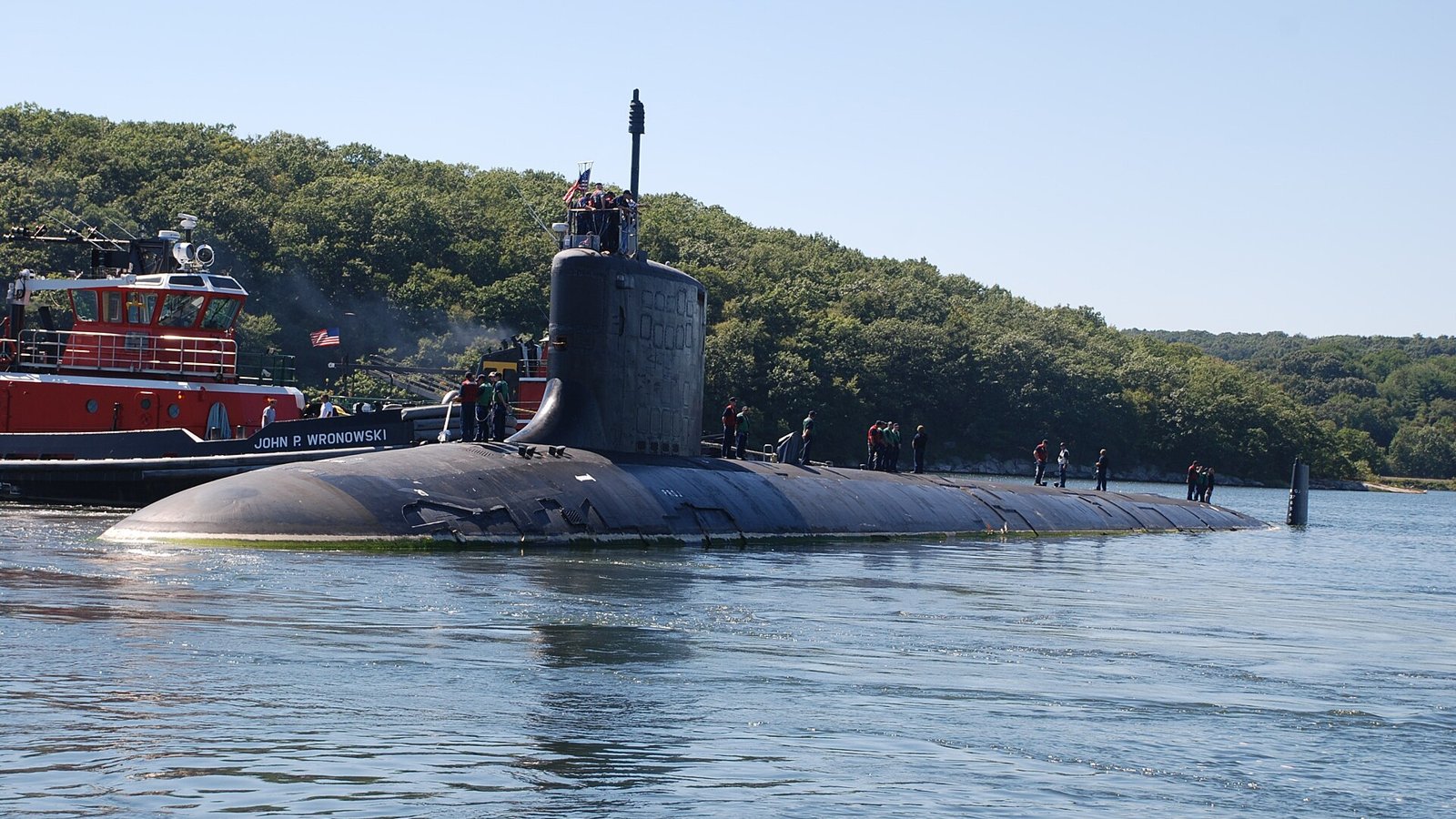
Japan is expected to state in revisions to its security documents by the year-end that it will "begin considering and reach a conclusion" on acquiring nuclear-powered submarines, the Japan Times reports. For a country whose Atomic Energy Basic Act limits nuclear power to peaceful purposes, that is a sentence that would have been politically unthinkable ten years ago.
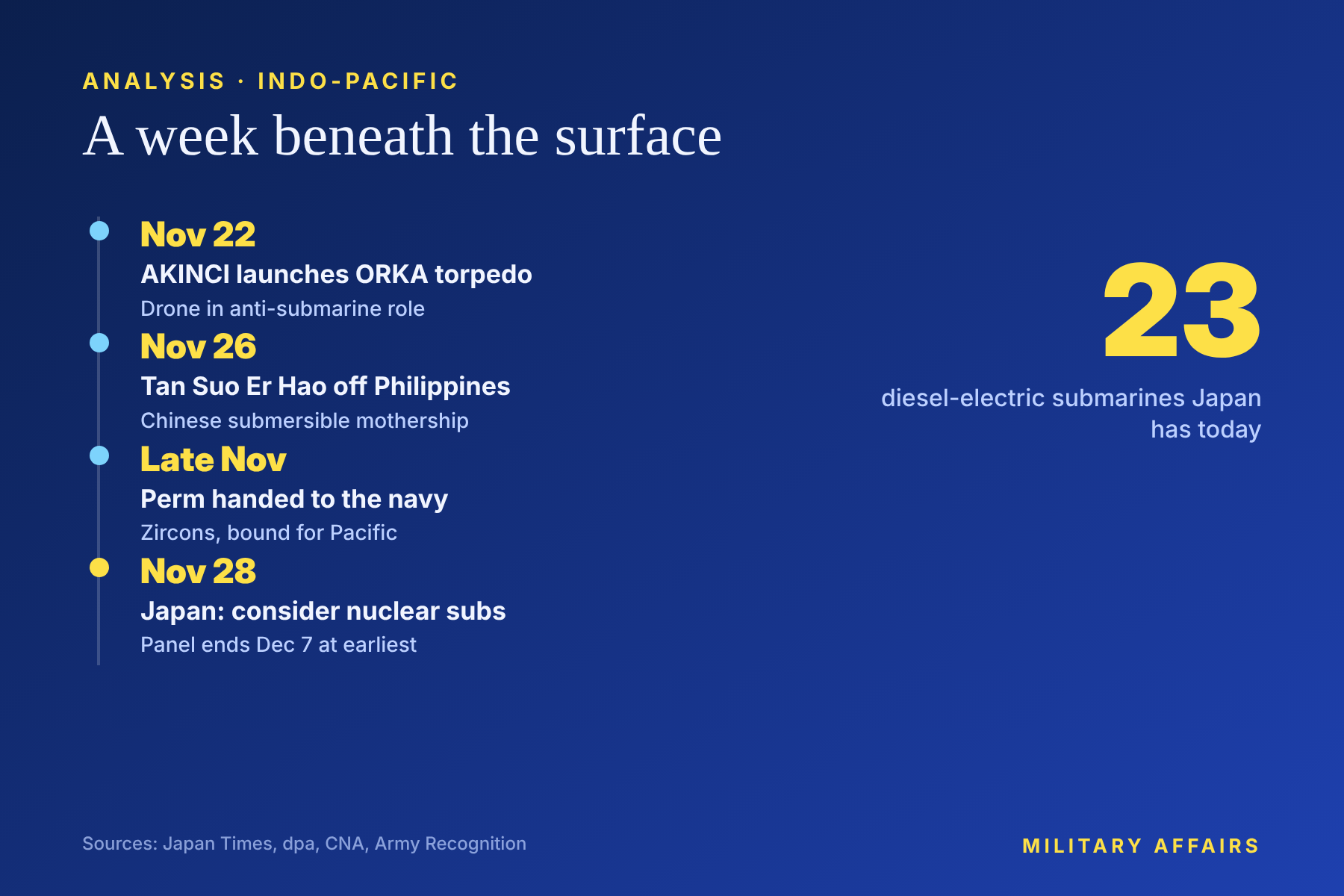
The decision does not come in a vacuum. In the same few days Russia handed the navy the Yasen-M class submarine Perm in Severodvinsk, the first with Zircon hypersonic missiles as standard armament, and announced it would join the Pacific Fleet. At the other end of the region, the Philippine Coast Guard tracked the Chinese vessel Tan Suo Er Hao, a mothership for crewed and uncrewed submersibles, as it surveyed the deep without permission 49 nautical miles off Ilocos Norte.
Why submarines
The Japan Times explains the logic: nuclear submarines can stay submerged longer and travel faster than diesel-electric boats, and can carry vertical launch systems for long-range missiles, serving a counterstrike capability. Defence Minister Shinjiro Koizumi says they "would allow crew members to engage in operations at a higher level of safety". Japan currently has 23 diesel-electric attack submarines.
Pressure comes from several directions. According to the same source, China is deploying carriers in the western Pacific and building an all-nuclear submarine fleet, while Russia and North Korea strengthen their military capabilities. Australia and South Korea have already opted for nuclear submarines. If Tokyo follows, the three most important US allies in the region would have or plan nuclear submarine fleets.
A Russian signal from the White Sea
Putin's message with the Perm was also aimed at the Pacific: "Russia is one of the few countries in the world capable of building such powerful nuclear submarines – weapons of global reach and significance." According to the Kremlin, the navy will receive five more missile submarines by 2030, including three Yasen-M boats. Moving the most modern submarine to the Far East is meant, according to dpa, to strengthen Russia's presence in the Arctic too, and it is also a message to Japan, whose waters lie between Russian bases.
Mapping the seabed as preparation
Less spectacular but perhaps more important is the case of Tan Suo Er Hao. The Chinese Academy of Sciences vessel was monitored in northern Philippine waters in May and December 2025, in April 2026 off Batanes near Taiwan, and now off Ilocos Norte. The Philippine Coast Guard says China is "becoming emboldened" and that deep-sea surveys are a concern for the international community too.
The reason is simple: submarine warfare depends on knowing the seabed, water temperature and salinity, data gathered precisely by such "scientific" missions. The passages between Taiwan and the Philippines are natural corridors for submarines moving from the South China Sea into the Pacific.
The hunters are changing too
Alongside submarines, anti-submarine warfare is changing. On November 22 a Turkish AKINCI drone launched an ORKA lightweight torpedo for the first time, showing how long-endurance unmanned aircraft could take over part of the work done until now by expensive crewed maritime patrol aircraft. For navies with limited budgets, that may be a cheaper way to "see" and threaten beneath the surface.
What comes next
Japan's expert panel is due to finalise its proposals as early as December 7. The obstacles are large: costs are estimated at trillions of yen, there is a shortage of engineers and crews with specialist knowledge, and the legal question remains open. But the very wording "consider and reach a conclusion" shows that Tokyo is no longer debating whether the subject is permitted, but when and at what price.
This analysis is based on reports by the sources listed.
Sources and references
- I.Japan TimesJapan expected to push for debate on nuclear subs in security document revisions🔗 https://www.japantimes.co.jp/news/2026/11/28/japan/japan-nuclear-submarines-security-documents/
- II.Bernama / dpaPutin Commissions Nuclear-powered Submarine Armed With Hypersonic Missiles🔗 https://www.bernama.com/en/world/news.php?id=2640878
- III.Free Malaysia Today / AFPPutin unveils new nuclear submarine🔗 https://www.freemalaysiatoday.com/category/highlight/2026/11/28/putin-unveils-new-nuclear-submarine
- IV.CNAPhilippines challenges Chinese vessel over 'illegal' survey off northern province🔗 https://www.channelnewsasia.com/east-asia/philippines-challenges-chinese-vessel-over-illegal-survey-northern-province-6590451
- V.Army RecognitionTürkiye's Roketsan ORKA Torpedo Launched From AKINCI Drone🔗 https://www.armyrecognition.com/news/navy-news/2026/tuerkiyes-roketsan-orka-torpedo-launched-from-akinci-drone-marks-a-shift-in-anti-submarine-warfare
Keep reading
Selected long reads to continue with.
 LONG READ
Who pays for Europe's rearmament: Germany borrows, the Nordics buy together, Switzerland rethinks neutrality
 LONG READ
The drone has become ammunition: unmanned warfare moves from tactics to industry
 LONG READ
Hormuz, the Red Sea and the Baltic: how freedom of navigation became a spoil of war, and why oil is still getting cheaper
 LONG READ
Comments 0
No comments yet.