The drone has become ammunition: unmanned warfare moves from tactics to industry
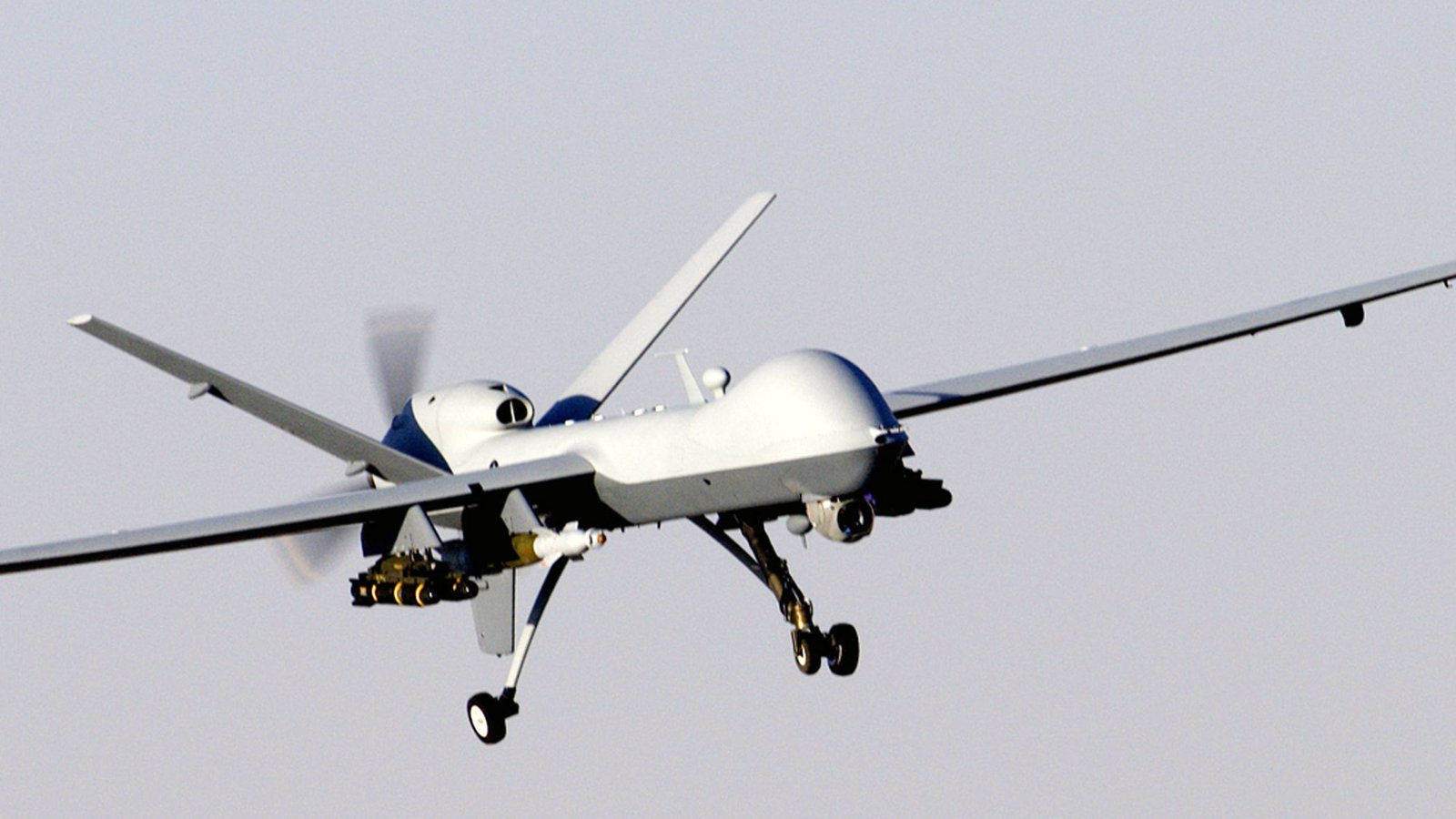
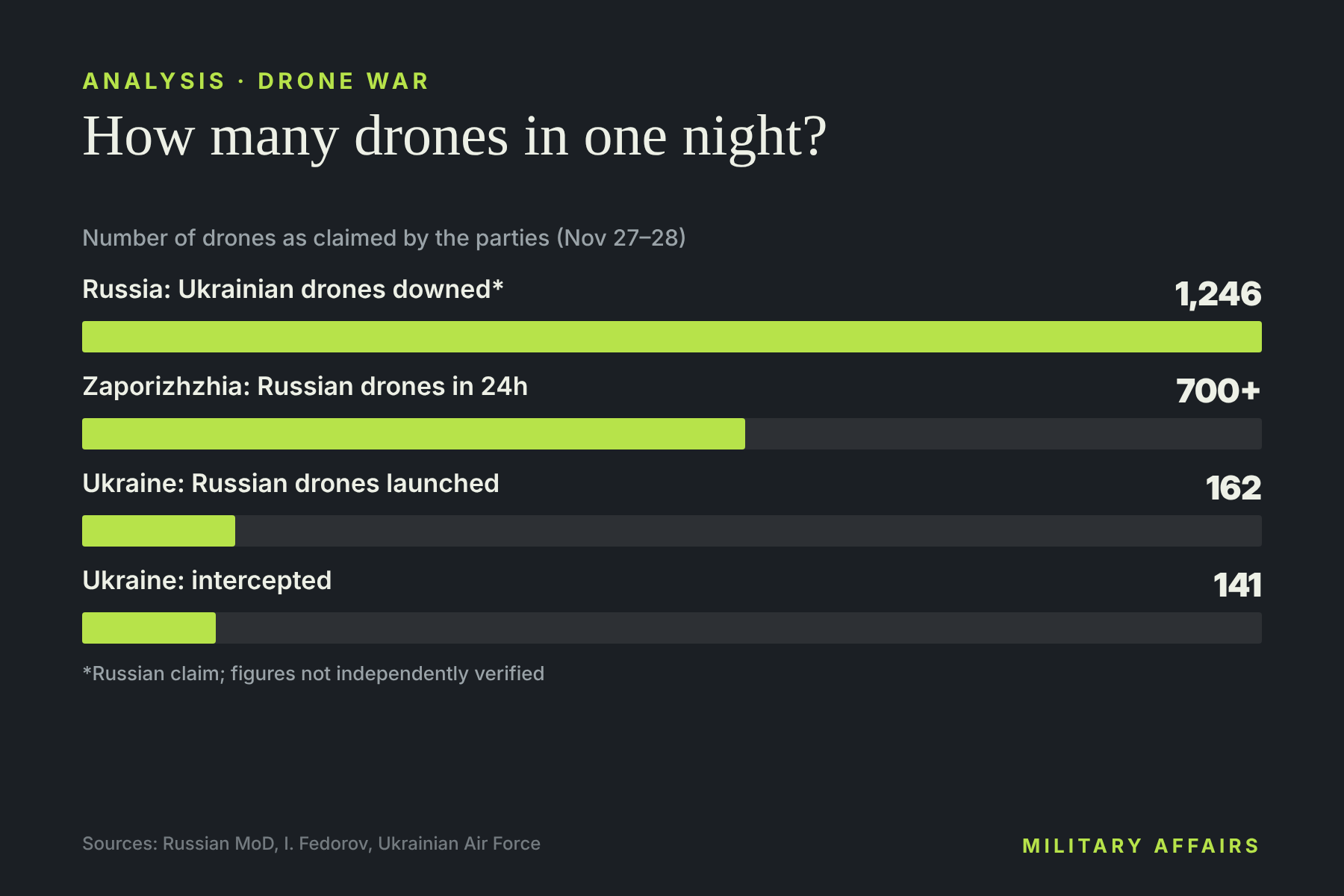
Russia's defence ministry said on November 28 that air defences had "intercepted and destroyed 1,246 Ukrainian fixed-wing unmanned aerial vehicles" in a single night, more than 460 of which, according to Moscow Mayor Sergei Sobyanin, were heading for the Moscow region. The same night Ukraine's Air Force reported 162 Russian drones, 74 of them jet-powered. A day earlier Zaporizhzhia regional chief Ivan Fedorov spoke of more than 700 Russian drones on his region in 24 hours.
These figures cannot be independently verified and should not be added together. But the order of magnitude is clear: the drone is no longer a special weapon but a consumable, something between an artillery shell and a cruise missile. And when a weapon becomes ammunition, the war is fought not only at the front but in factories, budgets and logistics.
Phase one: mass
The most visible shift is quantity. The two sides now exchange hundreds, and by Russian claims more than a thousand, aircraft a night. The Pentagon has caught on late: according to Defence Industry Europe, the US department has been trying for more than two years to acquire millions of cheap drones and is now in preliminary talks with Ford, General Motors and Canada's Magna about using auto-industry capacity. The Pentagon estimates the military drone market at $20–30 billion a year.
Carmakers' interest is mixed, the same source says: single-use drones carry thin margins and defence work brings reputational risk. But the very fact such talks are happening signals a paradigm shift. The Cold War was fought by the aerospace industry; the drone war needs a consumer-goods industry.
Phase two: hunting the hunters
The second change is organisational. Russia created its Unmanned Systems Forces as a new branch in late 2025, with the "Rubicon" Center for Advanced Unmanned Technologies at its core. According to the Kyiv Independent, Rubicon specialises in cutting logistics, hunting Ukrainian drone pilots and intercepting reconnaissance and strike drones, deepening the "kill zone" along the front.
Ukraine has responded by making the unit itself a priority target. Ukraine's Southern Forces say that on November 28 in occupied Berdiansk, 107 kilometres behind the front, they hit a pilot training base and the unit's leadership, killing more than 30. Unconfirmed: these claims have not been independently verified. But the logic matters more than the number: in a drone war, the operator and his school become more valuable targets than the aircraft.
Phase three: cheap interception
If the drone is ammunition, intercepting it with a missile worth hundreds of thousands of dollars becomes economically unsustainable. That is why perhaps the most important news of recent weeks is the smallest: Ukraine's Blysk laser system, according to presidential adviser Serhii Beskrestnov, downed a target in combat for the first time, reportedly a jet-powered Geran-4. Earlier available data put its power at four kilowatts and range at up to one kilometre.
Ukraine is not alone. Israel received its first Iron Beam system in December 2025, the Pentagon has contracted production units of the LOCUST X3, and Britain has ordered DragonFire for the Royal Navy for £316 million. The US and Israel tested about 20 counter-drone systems in the first "Black Sands" exercises, and Israeli Brig. Gen. Benny Aminov warned that civilian drone technology is "widely available" and the threat changes rapidly.
Interceptor drones are developing in parallel. Japan's Terra Drone delivered its AI-powered Terra B1 interceptor to the defence ministry three months after signing the contract, and Turkey's Aselsan demonstrated the naval GÖKDENİZ system, which detects and tracks targets on its own while an operator approves fire with a single command.
Phase four: the drone as fighter and submarine hunter
At the top of the pyramid are aircraft that are no longer "drones" in the old sense. On November 19 Baykar delivered the first three KIZILELMA unmanned fighters to Turkish security forces, and on November 22 an AKINCI drone launched an ORKA lightweight anti-submarine torpedo for the first time. Unmanned platforms are thus entering domains that until yesterday belonged to expensive crewed aircraft.
What it means for Europe and the Balkans
The incident over Britain's RAF Lakenheath, where, according to the Financial Times, US forces repelled six drones on November 13, is a reminder that the drone front is not only Ukrainian. For smaller states the lesson is twofold. First, counter-drone defence is no longer an add-on but a basic layer of air defence, and it must be cheaper than the threat. Second, the key capability is not buying finished systems but domestic serial production and operator training, because that, as the Rubicon case shows, is exactly what an adversary tries to destroy first.
This analysis is based on reports by the sources listed; claims by the warring parties about drones downed and losses have not been independently verified.
Sources and references
- I.CNA / AFPRussia says shot down more than 1,200 Ukraine drones overnight🔗 https://www.channelnewsasia.com/world/russia-ukraine-shot-down-drones-overnight-6589261
- II.Kyiv IndependentRussian attacks kill 10, injure 55 across Ukraine over past day🔗 https://kyivindependent.com/russian-attacks-kill-10-injure-55-across-ukraine-over-past-day-as-deadly-strike-hits-chernihiv-oblast-businesses/
- III.Kyiv Independent'Over 30 killed' — Ukraine hits Russia's elite 'Rubicon' drone unit base🔗 https://kyivindependent.com/over-30-killed-ukraine-hits-russias-elite-rubicon-drone-unit-base-in-occupied-zaporizhzhia-oblast/
- IV.Defence Industry EuropeU.S. Department of War in early talks with Ford and GM over parts for low-cost military drones🔗 https://defence-industry.eu/u-s-department-of-war-in-early-talks-with-ford-and-gm-over-parts-for-low-cost-military-drones/
- V.Defence Industry EuropeUkraine reports Blysk air defence laser downed a Russian drone in its first combat success🔗 https://defence-industry.eu/ukraine-reports-blysk-air-defence-laser-downed-a-russian-drone-in-its-first-combat-success/
- VI.Defence Industry EuropeJapan's Terra Drone says it delivered Terra B1🔗 https://defence-industry.eu/japans-terra-drone-says-it-delivered-terra-b1-atlas-first-domestically-built-ai-powered-autonomous-interceptor-drone/
- VII.Army RecognitionTürkiye's Roketsan ORKA Torpedo Launched From AKINCI Drone🔗 https://www.armyrecognition.com/news/navy-news/2026/tuerkiyes-roketsan-orka-torpedo-launched-from-akinci-drone-marks-a-shift-in-anti-submarine-warfare
- VIII.MigflugBayraktar KIZILELMA: First Three Jets Delivered🔗 https://migflug.com/afterburner/bayraktar-kizilelma-first-three-unmanned-fighters-delivered-turkiye-2026/
- IX.CNA / ReutersUS military repelled drones at UK airbase this month: Report🔗 https://www.channelnewsasia.com/world/us-military-repelled-drones-uk-airbase-6589176
Keep reading
Selected long reads to continue with.
 LONG READ
Who pays for Europe's rearmament: Germany borrows, the Nordics buy together, Switzerland rethinks neutrality
 LONG READ
The race beneath the surface: the Indo-Pacific enters the age of nuclear submarines as Japan breaks its last taboo
 LONG READ
Hormuz, the Red Sea and the Baltic: how freedom of navigation became a spoil of war, and why oil is still getting cheaper
 LONG READ
Comments 0
No comments yet.