Poland won't wait for NATO? What two ministers actually said, and why Narva is the scenario that frightens Warsaw
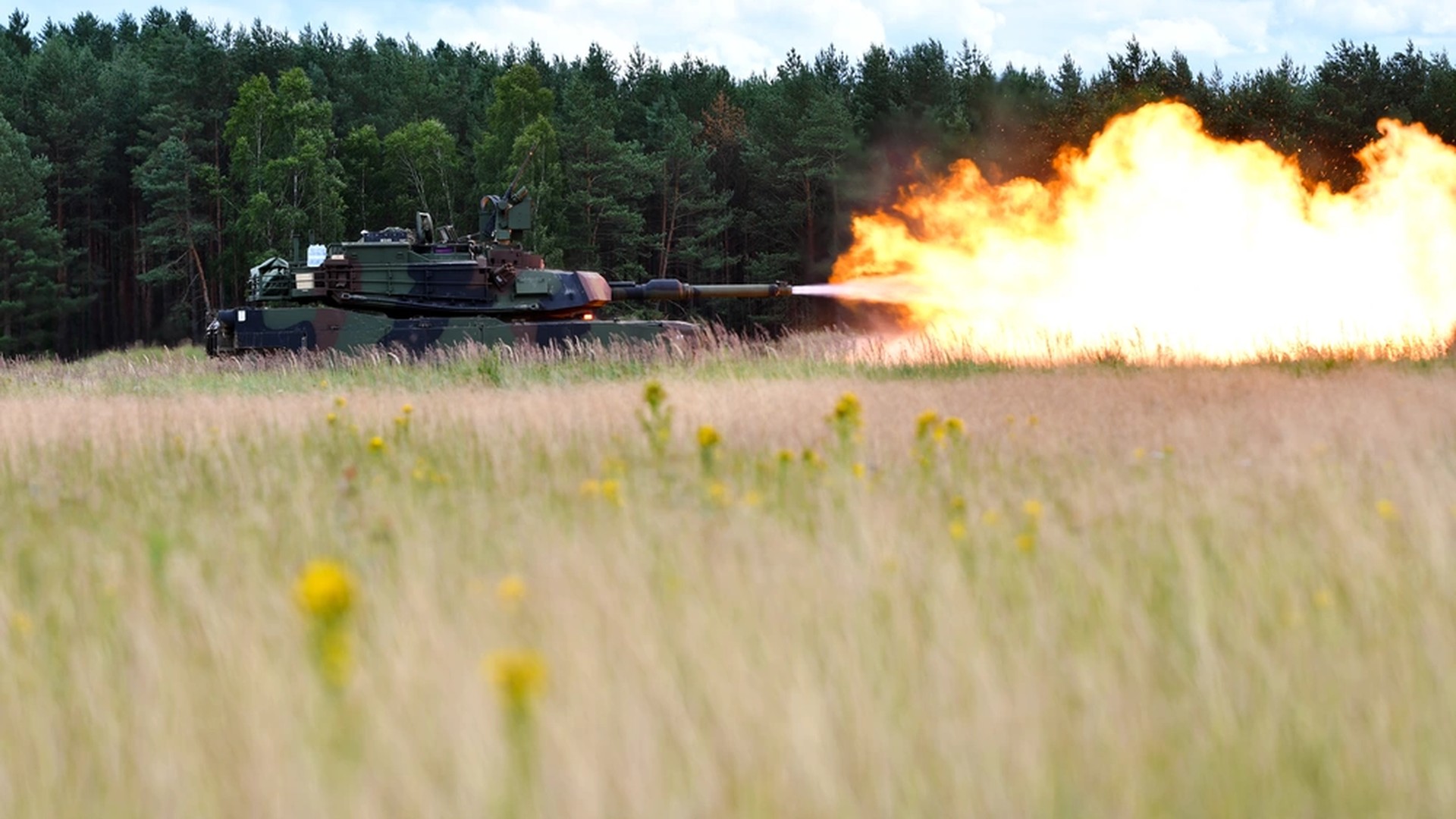
The sentence shared thousands of times in recent days runs roughly like this: Poland says it will immediately deploy its military to Estonia, Latvia or Lithuania if Russia attacks, without waiting for approval from NATO or Washington. It sounds like a watershed decision. It is not. But what lies behind it deserves more attention than the post itself.
From an anonymous source to "Poland says"
The source is a November 27 report by Polish outlet Onet, citing two unnamed ministers. According to accounts by Militarnyi and UNITED24 Media, one of them says that in the event of a Russian provocation Poland would immediately send armed forces to the attacked Baltic state. The other is more cautious: help must not weaken Poland's own defence, so special operations forces would be more likely than tank units. They agree on one thing, that Poland would take part.
The government has announced no such decision. Neither the prime minister nor the defence minister has confirmed it. So it is not that "Poland says"; two members of the government, unnamed, have floated a position under discussion in Warsaw. That is the difference between state policy and a trial balloon.
What Article 5 actually requires
The second inaccuracy is in the framing itself, as if Poland would thereby "bypass" NATO. Article 5 of the North Atlantic Treaty does not say anyone must wait for permission. It says each member will assist the party attacked by taking, individually and in concert with the others, such action as it deems necessary. The right of collective self-defence also exists under Article 51 of the UN Charter: an attacked state may call on an ally for help without anyone's consent.
According to UNITED24 Media, Onet's sources describe the aim in just those terms: a rapid Polish intervention would be meant to accelerate the activation of Article 5, not replace it. The phrase about "permission from Washington" does not come from those reports.
Why Narva
The scenario under discussion, according to Onet, is not an invasion of the Baltics. The intelligence assessments it cites say Russia currently has neither the capability nor a plan for full-scale war against a NATO member. The fear is of a different kind: a limited incursion, the seizure of a border settlement, or an entry into Narva, the Estonian city right on the border.
Such a move would be small enough for some allies to start debating whether it is an "armed attack" at all, and large enough, if it went unanswered, to show that collective defence does not hold. An alliance that decides by consensus is vulnerable precisely to situations that are ambiguous. While thirty-two capitals coordinate, the facts on the ground have already changed.
Hence the logic of the Polish sources: if an ally goes in at once, the question is no longer whether NATO will defend a village in Estonia, but whether it will abandon Polish soldiers under fire. Poland would, in other words, turn itself into the tripwire that activates the alliance.
Why this is being said now
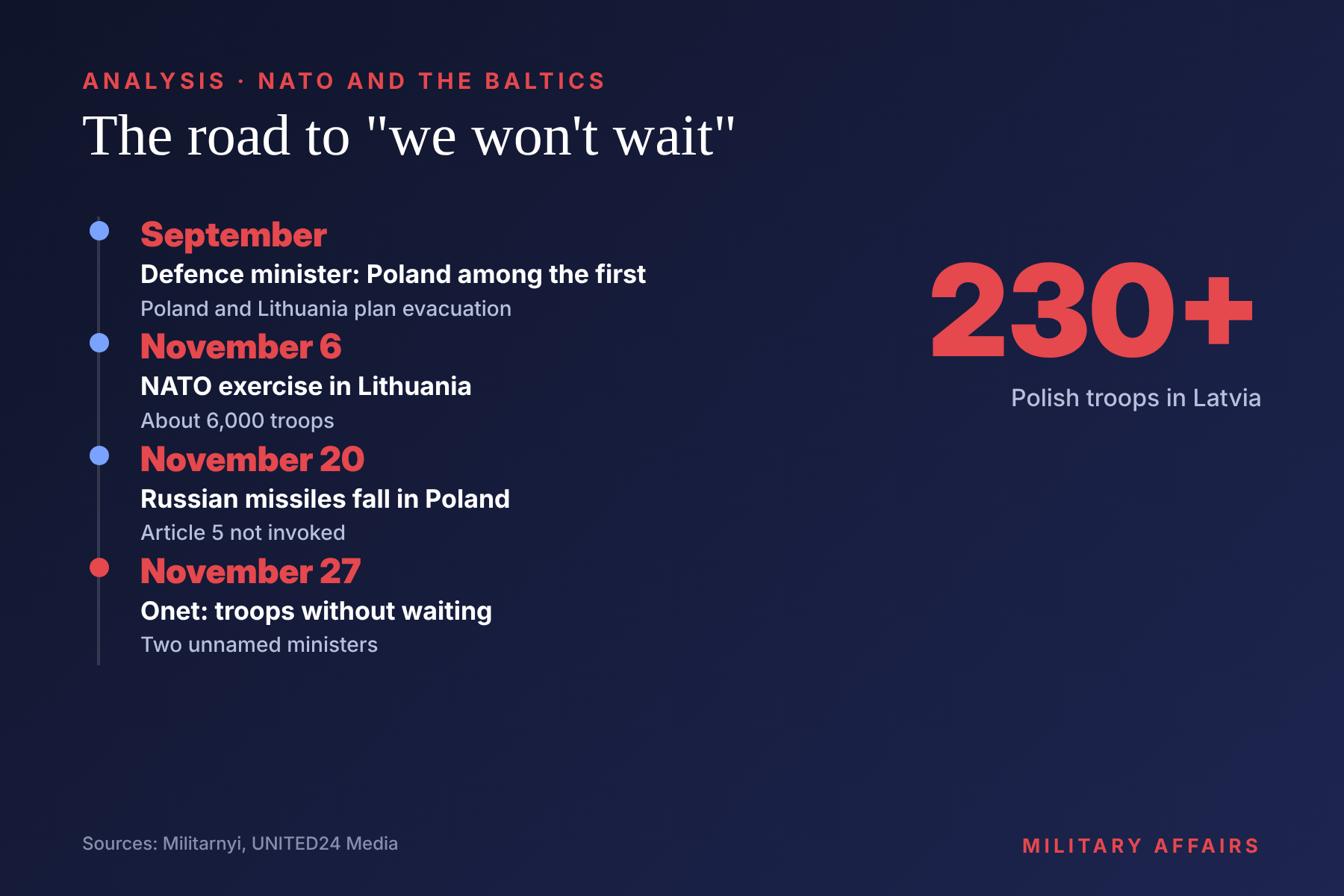
The timing is not accidental. On November 20 Russian missiles fell in eastern Poland during an attack on Ukraine. Prime Minister Donald Tusk said it looked like a deliberate provocation; the North Atlantic Council met, but Article 5 was not invoked. For Warsaw that was a practical lesson in how high the threshold is when an incident is "limited".
Circumstances are piling up elsewhere too. A NATO exercise with about 6,000 troops began in Lithuania on November 6, with one aim being interoperability among German, Lithuanian and Polish units. Poland and Lithuania have since September been preparing a plan to evacuate the Baltic states' population across their shared border. Czech Chief of the General Staff Miroslav Hlaváč has warned, according to UNITED24 Media, that Russia could launch a limited attack to test the alliance's unity.
Official Warsaw points the same way, only in more careful words: Defence Minister Władysław Kosiniak-Kamysz said in September that Poland should be among the first to help the Baltic states and should call for Article 5 to be invoked.
Where the story is thin
Three caveats are worth more than the headline. The first is constitutional: according to The Defense News, deployments abroad are formally approved by the president at the government's request, and Onet did not confirm that President Karol Nawrocki had been consulted. In a country where government and president come from opposing camps, "immediately" may take a while.
The second is military. The more cautious minister himself concedes resources are limited. Special forces can send a political signal, but they cannot retake a seized city. More than 230 Polish troops are already in Latvia as part of NATO's battlegroup, meaning Poland is present in the Baltics, but symbolically.
The third is political: the same outlet notes that within Poland's opposition there is a view that the army should above all defend Poland. A decision to send soldiers into someone else's war, even an ally's, would not pass without resistance.
What to watch
If this was a trial balloon, the response will show in three places. Whether anyone in government repeats the position on the record. Whether Tallinn, Riga and Vilnius publicly welcome the idea or pass over it in silence. And whether other allies on the eastern flank adopt the logic of "help first, procedure later". If that happens, NATO will acquire an informal first echelon that does not wait for consensus, which would both strengthen deterrence and concede that the alliance's own speed is no longer fully trusted.
This analysis is based on accounts of Onet's report; the original was not available to the newsroom. The anonymous ministers' statements have not been officially confirmed.
Sources and references
- I.MilitarnyiPoland Ready to Send Troops to Baltic States if Russia Attacks, Onet Reports🔗 https://militarnyi.com/en/news/poland-ready-to-send-troops-to-baltic-states-if-russia-attacks-onet-reports/
- II.UNITED24 MediaPoland Ready to Deploy Troops Against Russia in the Baltics Without Waiting for NATO's Article 5🔗 https://united24media.com/world/poland-ready-to-deploy-troops-against-russia-in-the-baltics-without-waiting-for-natos-article-5-24809
- III.The Defense NewsPoland Ready to Send Troops to Baltic States Immediately if Russia Attacks, Without Waiting for NATO Article 5🔗 https://www.thedefensenews.com/Poland-Ready-to-Send-Troops-to-Baltic-States-Immediately-if-Russia-Attacks-Without-Waiting-for-NATO-Article-5/
- IV.NATOThe North Atlantic Treaty (1949)🔗 https://www.nato.int/cps/en/natohq/official_texts_17120.htm
Keep reading
Selected long reads to continue with.
 LONG READ
From wartime ally to unwelcome guests: why Sarajevo is expelling Tehran's men now, and why its institutions stay silent
 LONG READ
Who pays for Europe's rearmament: Germany borrows, the Nordics buy together, Switzerland rethinks neutrality
 LONG READ
The race beneath the surface: the Indo-Pacific enters the age of nuclear submarines as Japan breaks its last taboo
 LONG READ
Comments 0
No comments yet.