Nobel Prize in Medicine to Deisseroth, Hegemann and Nagel for optogenetics
The Nobel Assembly at Karolinska Institutet on October 5 awarded the Nobel Prize in Physiology or Medicine to Karl Deisseroth, Peter Hegemann and Georg Nagel "for their discoveries concerning light-gated ion channels and optogenetics".
In the early 2000s Hegemann and Nagel discovered channelrhodopsin, a protein from the single-celled alga Chlamydomonas. When blue light hits it, a channel opens, ions flow into the cell and an electrical impulse is created. Any cell given the protein becomes light-sensitive.
From alga to brain
In 2005 Deisseroth inserted the channelrhodopsin gene into rat nerve cells and fired them with blue light, and two years later he made it work in the brains of living mice. The result was optogenetics, which researchers use to find the neural circuits behind memories, feelings and behaviours relevant to neurological and psychiatric disorders. In clinical medicine it is being tested as a way to restore sight.
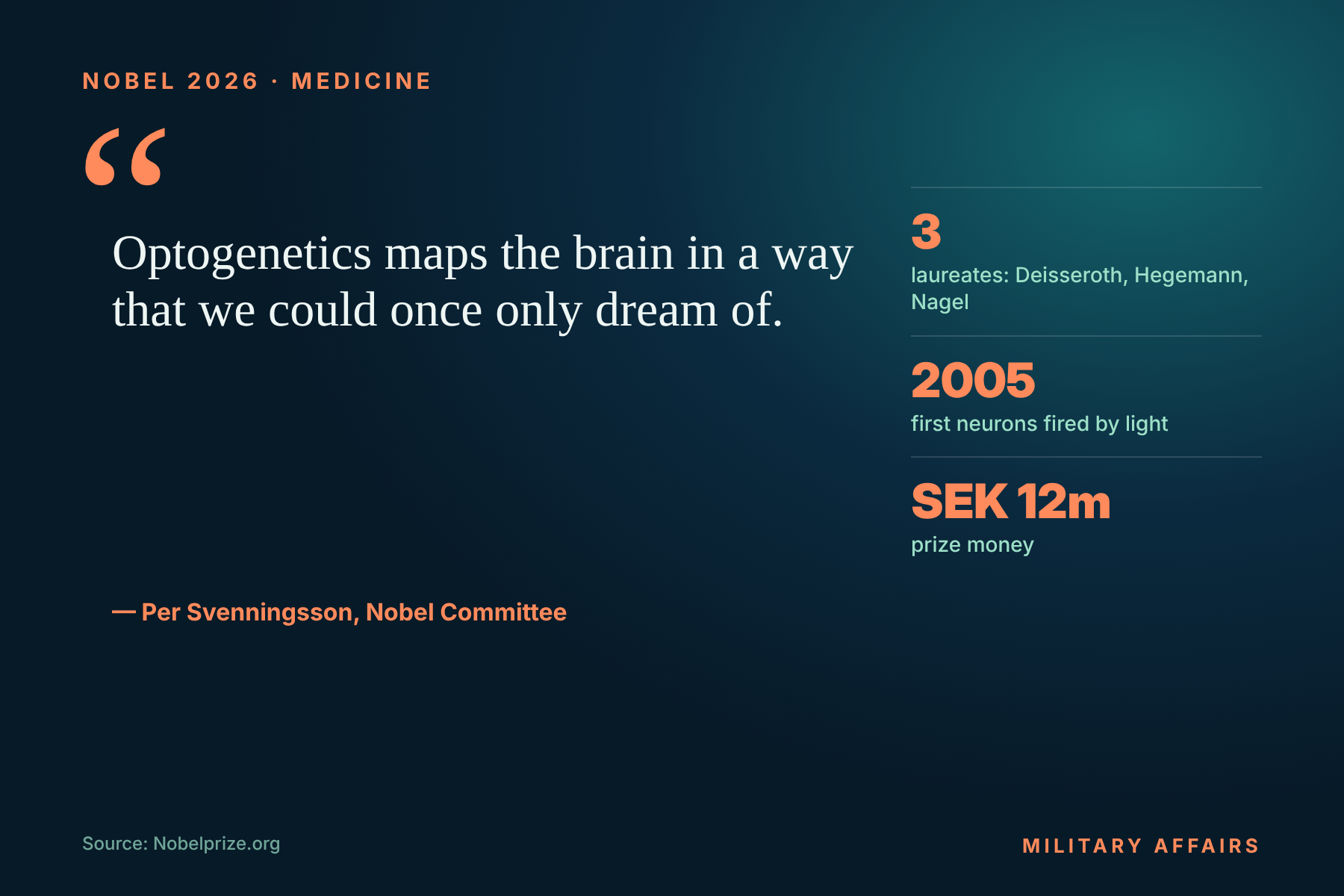
Optogenetics maps the brain "in a way that we could once only dream of", said Per Svenningsson, chair of the Nobel Committee.
Sources and references
- I.Nobelprize.orgNobel Prize in Physiology or Medicine 2026, press release🔗 https://www.nobelprize.org/prizes/medicine/2026/press-release/
- II.GPB / APNobel medicine prize goes to 3 scientists for research into brain activity🔗 https://www.gpb.org/news/2026/10/05/nobel-medicine-prize-goes-3-scientists-for-research-brain-activity
Keep reading
Selected long reads to continue with.
 LONG READ
Referendum at the gas pump: how the war with Iran cost Trump Congress
 LONG READ
The Baltic “NATO lake” and the escalation trap: how hybrid war is nearing the threshold of open conflict
 LONG READ
A siege that endures: Mali between a jihadist blockade and Russian support
 LONG READ
Comments 0
No comments yet.