Antarctic ozone hole is the largest in a decade: 27.1 million square kilometres
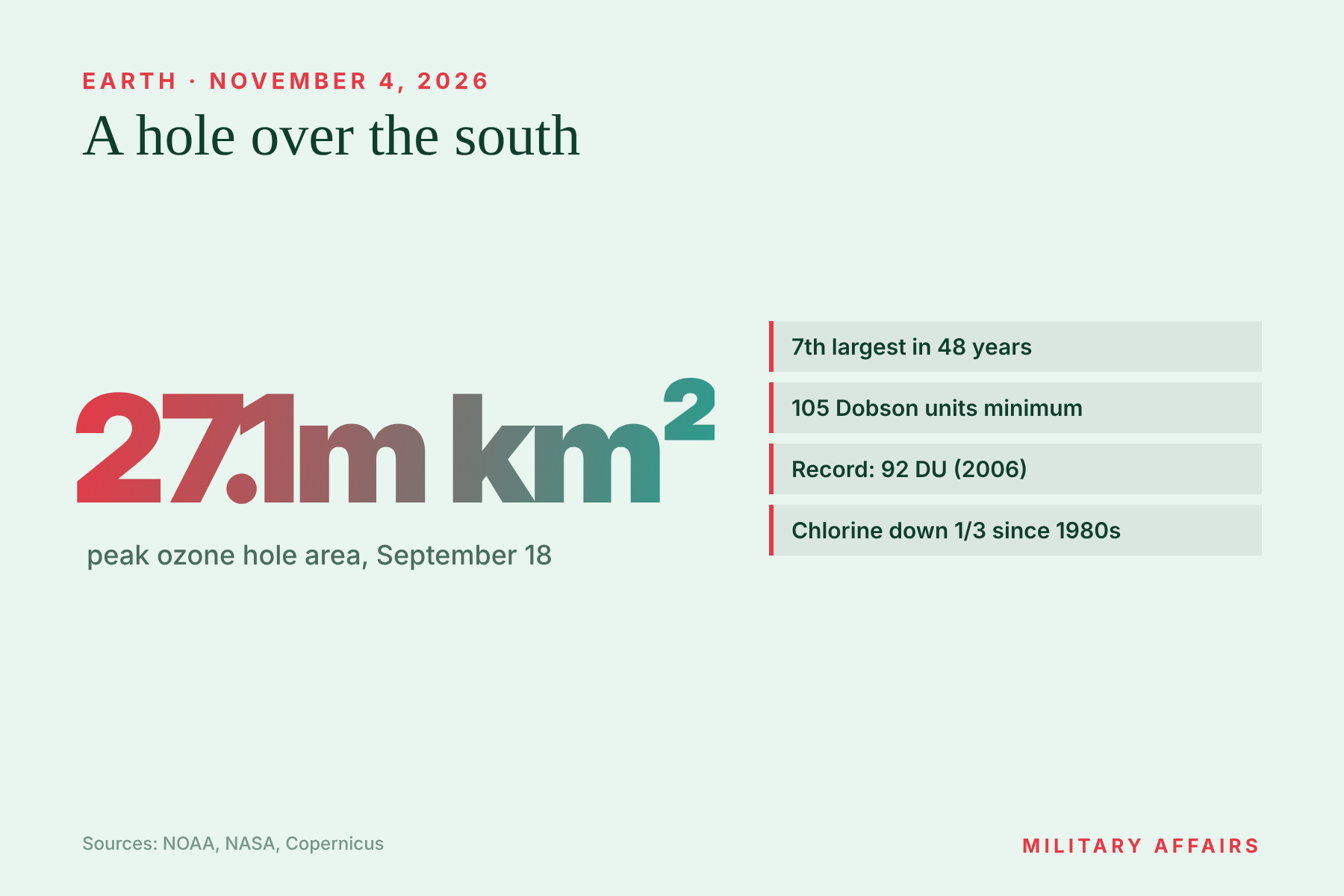
The Antarctic ozone hole reached its largest area in ten years on September 18, 27.1 million square kilometres, NOAA and NASA said on November 4. Its average area from September 7 to October 13 was about 25 million square kilometres, the seventh largest in 48 years of measurements.
The lowest ozone reading, 105 Dobson units, came on October 17; the record low of 92 units was set in 2006. Europe's Copernicus measured a peak of 27.4 million square kilometres on September 20.
Why so big
"The polar vortex was unusually large this year," said Amy Butler of NOAA. Stratospheric chlorine has nevertheless fallen by about a third since the 1980s thanks to the Montreal Protocol, so scientists still expect the ozone layer to recover by mid-century.
Sources and references
- I.NOAANOAA, NASA release measurements of 2026 ozone hole🔗 https://www.noaa.gov/news-release/noaa-nasa-release-measurements-of-2026-ozone-hole
- II.Copernicus CAMSOzone hole reaches notable threshold early🔗 https://atmosphere.copernicus.eu/copernicus-ozone-hole-reaches-notable-threshold-early-again-area-increases-above-average-2026
Keep reading
Selected long reads to continue with.
 LONG READ
Referendum at the gas pump: how the war with Iran cost Trump Congress
 LONG READ
The Baltic “NATO lake” and the escalation trap: how hybrid war is nearing the threshold of open conflict
 LONG READ
A siege that endures: Mali between a jihadist blockade and Russian support
 LONG READ
Comments 0
No comments yet.